Introduction
Aerodigestive foreign body (FB) ingestion and aspiration are among the most frequent pediatric emergencies worldwide, particularly in children under 5 years of age.1,2 Their developmental curiosity, tendency to explore the environment orally, and immature dentition predispose them to accidental FB ingestion and aspiration.3–5 These events can have life-threatening consequences depending on the nature, size, and location of the object as well as the duration of time before definitive intervention.6 Aspirated foreign bodies may precipitate acute airway obstruction, severe respiratory distress, or death, while ingested objects often become lodged at locations of physiologic esophageal narrowing, which causes obstruction, mucosal erosion, perforation, mediastinitis, or catastrophic hemorrhage. Perioperative outcomes vary significantly across health care systems,7 and timely recognition and management continue to be essential, particularly in settings where specialized pediatric surgical or endoscopic resources are limited.8,9
Although this problem is well recognized globally, relatively little data about pediatric outcomes are available from low- and middle-income countries (LMICs) where delays in diagnosis is frequently compounded by limited access to advanced imaging, safe anesthesia services, and pediatric bronchoscopy/esophagoscopy resulting in higher rates of complications and mortality.1,2,9 Literature from high-income settings describes a wide spectrum of clinical presentations, ranging from subtle or asymptomatic ingestions to life-threatening airway crises following aspiration.10,11 Detailed studies have characterized anatomic determinants; these include the equal bronchial bifurcation angle in children,12 the rapid caustic injury caused by button batteries,13 the potential for sharp objects to erode into major vessels,14 and the diagnostic limitations of radiolucent FBs.15 However, only a handful of studies in LMICs have specifically evaluated how late presentation, limited bronchoscopy capacity, economic constraints, and fragmented referral pathways influence morbidity and mortality.9,16–18 These discrepancies emphasize the need for contextually grounded data to understand the burden of disease in resource-limited environments, where reliance on clinical suspicion often substitutes for advanced diagnostics.9
The aim of this study is to describe clinical outcomes and identify factors associated with adverse events among children presenting with aerodigestive FBs at AGC Tenwek Hospital, a major referral center serving a predominantly rural population. By examining mortality patterns, adverse event rates, and associated risk factors, this study aims to characterize the local determinants of outcomes among children with aerodigestive FBs. Ultimately, these findings are intended to inform the development of context-appropriate protocols for early recognition, timely referral, and optimal management of ingested and aspirated FBs in similar settings, thereby reducing preventable morbidity and mortality.
Methods
Study site
This study was conducted at AGC Tenwek Hospital, a tertiary referral center located in rural Bomet County, Kenya. The hospital serves a large catchment population from multiple surrounding counties and frequently receives pediatric emergencies referred from other health facilities. Tenwek is equipped with pediatric surgical, endoscopic, and critical care services, which makes it a regional hub for the management of aerodigestive FBs.
Study design and variables
A descriptive retrospective study design was employed. All consecutive cases were reviewed over the defined time period. Independent variables included age, time from symptom onset to presentation, witnessed versus unwitnessed ingestion/aspiration, type of FB, and anatomic location within the aerodigestive tract. The primary dependent variables were mortality rate and overall adverse event rate. Adverse events were defined as any documented intraoperative or postoperative complication attributed to either the FB itself or its management during the index hospitalization (including death). These included esophageal or mucosal injury/erosion, mediastinitis, mucous plugging, airway edema, perforation, bleeding, postoperative ventilatory support, unplanned intensive care admission, and other procedure-related complications documented in the medical record. Adverse events were determined through retrospective review of operative reports, inpatient clinical documentation, anesthesia records, radiologic findings, and discharge summaries. Secondary outcomes included the distribution of FB types and patterns of presentation.
Study population and eligibility criteria
The study population included all patients under 18 years of age who presented to AGC Tenwek Hospital with aerodigestive FBs between January 2017 and March 2022. We included patients with aerodigestive FB ingestion or aspiration diagnosed clinically, radiologically, or endoscopically within the study period. We excluded FBs located outside the aerodigestive tract (eg, external auditory canal, skin) or patients with incomplete records preventing assessment.
Data collection, management, and analysis
Patient data were extracted from electronic medical records, operative logs and registers, and ward admission files using a structured data abstraction tool. All entries were compiled in Microsoft Excel, where they were cleaned for completeness, typographical inconsistencies, and duplicate entries. Deidentified data were then analyzed with Stata version 16.1 for descriptive statistical analysis, including frequencies, proportions, measures of central tendency, and analysis of risk factors with outcomes. Associations were analyzed using Pearson’s chi-squared test and Wilcoxon rank-sum test, with statistical significance defined as P < 0.05.
Ethical considerations
Because this study involved a retrospective chart review of existing patient records, informed consent was waived by the ethics committee. All personally identifiable information was removed and replaced with unique serial numbers to maintain confidentiality. Ethical approval for the study (2024-0015) was obtained from the Tenwek Hospital Institutional Scientific Ethics and Research Committee and subsequently registered with the National Commission for Science, Technology and Innovation (NACOSTI) in accordance with national research regulations.
Results
A total of 173 cases were reviewed and confirmed to have an aerodigestive FB after excluding 6 patients who underwent a negative evaluation and 7 patients with missing charts. The median age of presentation was 3 years old (IQR of 2–4). The most common presenting symptoms, presenting vital signs, and imaging used in diagnosis and evaluation are detailed in Table 1. FB locations were distributed as follows: 82 (47.4%) involved ingestion, 53 (30.6%) were aspiration, and 38 involved the upper aerodigestive and nasal passage (22.0%).
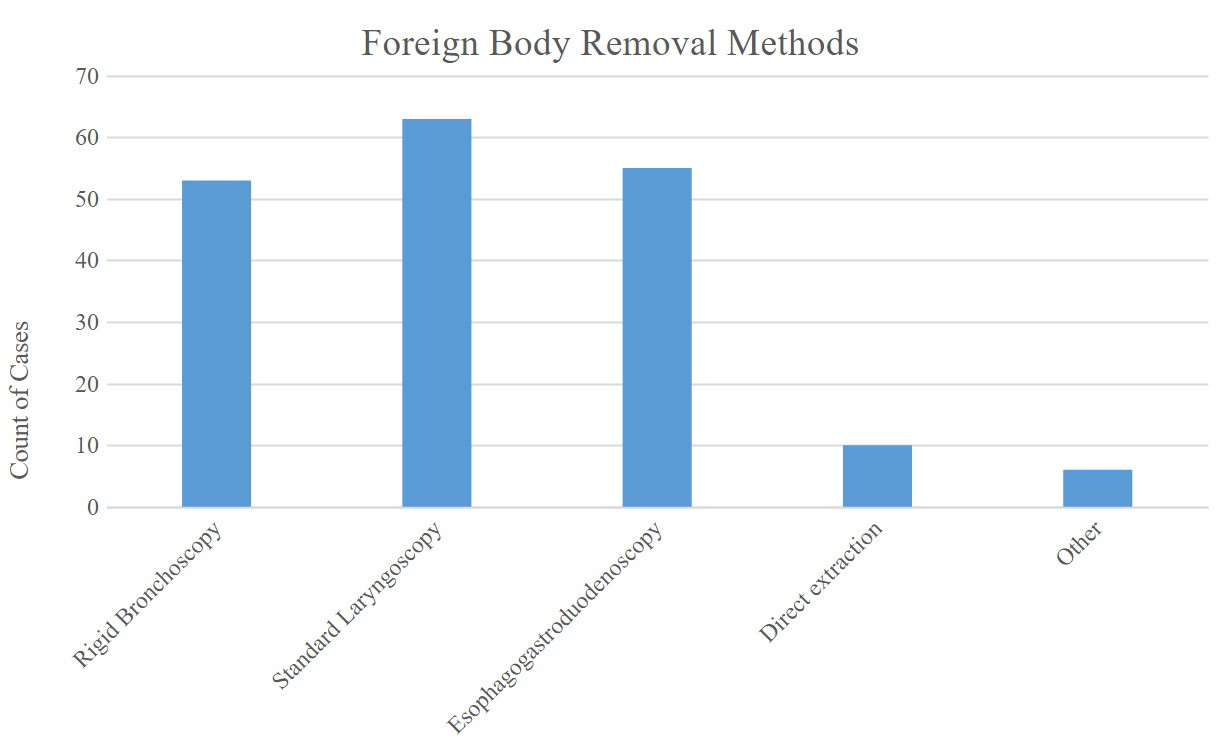
The method of FB removal is displayed in Figure 1. Removal methods described fewer than 2 times were laparotomy, nasopharyngoscopy, tracheostomy, and thoracotomy.

The intraoperative findings and postprocedure outcomes are detailed in Table 2. Notably, postprocedure ventilation was required in 9 patients (5.2%). The median length of hospital stay was 1 day (IQR of 1–3 days).
Adverse events occurred in 29 patients (16.8%), which included 4 deaths (2.3%) reported during the study period. Three of those deaths occurred due to airway FB aspiration (3/53, 5.7%) and one occurred due to the ingestion of a button battery resulting in mediastinitis (1/82, 1.2%). Adverse events were associated with children who presented as symptomatic, delayed presentation beyond 24 hours, the involvement of battery button, and physiologic derangement at presentation (Table 3). Adverse events were associated with longer median hospital stay of 3 days (IQR of 3–6) and postoperative ventilation of 7 (24.1%) compared to those without an adverse event having a median hospital stay of 1 day (IQR of 1–2) and postoperative ventilation of 2 (1.4%), respectively. The most common adverse events were esophageal erosion or injury,7 mucosal erosion,2 and mucous plug.2
Only 66 (38.4%) patients were brought in following a witnessed event. Table 4 compares the timing of presentation between witnessed and unwitnessed FB events. This difference was statistically significant, which suggests that witnessed events are more likely to result in prompt presentation and intervention.
Discussion
This study demonstrates that aerodigestive FBs are an important cause of pediatric morbidity and mortality in a rural Kenyan referral setting, and a small subset of presentations carry disproportionately higher risk. Among 173 children, the median age was 3 years old, with ingestion more common than aspiration. Overall, 16.8% (N = 29) experienced an adverse event and 2.3% died (N = 4), indicating a substantial burden despite access to definitive endoscopic and surgical care. Our findings are consistent with global literature and fall within the range reported from high- and low-resource centers with 0.4%–7% mortality.2,6,19 Button battery ingestion, delayed presentation beyond 24 hours, the presence of symptoms, and higher heart rate at presentation were significantly associated with complications. These findings suggest that both the intrinsic characteristics of the FB and modifiable system factors related to delayed care contribute to the risk profile of children with aerodigestive FBs in this context.
The age distribution and types of aerodigestive foreign bodies observed in this cohort are similar to those reported in other pediatric series.1,6,20 The median age of 3 years old, with most patients in the preschool range, reflects the well-recognized vulnerability of young children who explore their environment orally and lack mature dentition. Coins were the most frequent FBs, followed by seeds, which is consistent with reports from both high-income and low- and middle-income settings that identify small metallic objects and food items as the most predominant hazards.21 Button batteries accounted for 8.7% of our FBs, but they were clinically important because of their strong association with adverse events in this study, supporting existing evidence that these objects cause rapid tissue injury and are disproportionately harmful relative to their frequency.13,22 Globally, button batteries account for an estimated 7%–25% of all pediatric FB ingestions, with most cases occurring in children <6 years old according to the European Society for Paediatric Gastroenterology, Hepatology, and Nutrition (ESPGHAN).23 The higher rate of complications among children with button batteries compared to other FB types is consistent with the known pathophysiology of alkali and electrochemical injuries, which can lead to deep mucosal damage, perforation, and catastrophic hemorrhage within a short period of time.22 The ESPGHAN guidelines identify esophageal button batteries as a time-critical emergency requiring removal within 2 hours due to rapid tissue injury.23 Our finding that button battery ingestion was strongly associated with adverse events aligns with these recommendations and underscores the need for immediate triage and early endoscopic access to reduce preventable complications. The overall pattern of FB types and locations appears broadly comparable to the international literature while providing locally relevant data from a rural referral hospital in Kenya.
The timing of presentation and whether the event was witnessed emerged as important contributors to outcomes in this cohort.4,24 Although most children presented within 72 hours, the median time to presentation was 24 hours with a wide IQR, and nearly half arrived at or after 24 hours from symptom onset or suspected event. This is longer than other reports,1,4,25 and therefore suggests a need for earlier referral of patients with suspected aerodigestive FBs from lower tier hospitals and clinics to definitive care centers. Witnessed events were significantly more likely to result in earlier presentation, as shown by the higher proportion of children brought to the hospital within 24 hours when the ingestion or aspiration had been observed.26 Delayed presentation beyond 24 hours, in turn, was associated with a higher frequency of an adverse event, together with the presence of symptoms and increased heart rate at admission, which suggest that physiologic derangement and evolving local injury often accompany late referral.24 Caregiver recognition and early care seeking are critical modifiable steps in the pathway from exposure to definitive management and unwitnessed events, particularly in younger children, which may silently progress to more severe pathology before reaching a facility capable of providing endoscopic or surgical intervention.
Diagnostic and management patterns in this cohort reflect a resource-appropriate approach for a rural referral center in a low- and middle-income settings. Most children underwent plain radiography, with the majority receiving an anteroposterior chest X-ray and a smaller proportion receiving lateral and abdominal views, while computed tomography (CT) was sparingly used. High-quality CT imaging has demonstrated a high sensitivity for radiolucent airway FBs and can identify subtle complications such as mediastinal air or early perforation, but its routine use may not be practical or necessary in most pediatric cases in resource-limited settings. Yet, it may have a selective role in equivocal cases, suspected complications, discordance between endoscopic findings and clinical suspicion, or in reducing unnecessary negative bronchoscopy evaluations27; however, a further study would be necessary to evaluate this within our context. The reliance on simple imaging, combined with clinical assessment, was sufficient to identify and localize the FB in most cases and to guide intervention.25 Definitive management was predominantly through endoscopic techniques, including standard laryngoscopy, rigid bronchoscopy, esophagoscopy, and related procedures. Open surgical intervention with laparotomy, tracheostomy, and thoracotomy was required in a small minority of patients due to failed endoscopic retrieval or advanced complications such as perforation or mediastinitis. In these severe cases, thoracotomy or laparotomy were life-saving measures reflecting advanced disease at presentation rather than procedural failure, which is often related to delayed referral. Six children in our records underwent negative endoscopic evaluation, and no FB was ultimately identified; however, negative procedures are an unavoidable component of managing suspected aerodigestive FBs, particularly in young children with unwitnessed events and nonspecific presentations, where the consequences of a missed diagnosis may be catastrophic. Reported negative bronchoscopy rates in the literature range widely from approximately 10% to 61% depending on clinical protocols and case selection; this supports the principle that in high-risk scenarios, clinical suspicion should supersede radiographic findings to minimize the risk of overlooking a retained airway or esophageal FB.27
The median hospital stay of 1 day for the overall cohort and the relatively low proportion requiring postoperative ventilation suggest that once children reached a facility with appropriate expertise and equipment, timely removal and recovery were usually achievable. These patterns underscore the importance of maintaining continuous access to pediatric airway and endoscopic services at regional referral hospitals, while also highlighting that system-level improvements must focus on earlier recognition and referral from peripheral facilities to reduce the burden of complications that are already established at the time of presentation. The 4 deaths observed in this study occurred in children who presented with either severe airway compromise following aspiration or advanced esophageal injury from button battery ingestion, underscoring the narrow therapeutic window and the devastating consequences of delayed recognition and intervention.
This study has several strengths and limitations that should be considered when interpreting the findings. Strengths include a relatively large sample of 173 children, managed at a high-volume rural referral hospital, with consistent availability of pediatric surgical and endoscopic services operating throughout the day and night. Detailed clinical, imaging, and outcome data allowed quantification of both mortality and a range of adverse events, and the focus on a predominantly rural population addresses an important evidence gap from LMIC settings. However, the retrospective design limits control over data quality and introduces the possibility of information bias, particularly in cases where documentation of symptoms, timing, or physiologic parameters was incomplete. Cases with missing charts and those with negative evaluations were excluded, which may affect estimates of presentation patterns and outcomes. The study was conducted at a single tertiary referral center, which likely overrepresents more severe, delayed, or complicated presentations compared with a district hospital or community setting, so generalizability to facilities with different resources or referral patterns may be limited. In addition, long-term sequelae, such as esophageal strictures or airway stenosis, were not systematically captured, and analyses were restricted to bivariate associations without adjusting for potential confounders. These limitations mean that causal inferences cannot be made, and the findings should be interpreted as descriptive and hypothesis-generating rather than definitive.
The findings of this study have important implications for clinical practice, health systems strengthening, and potential future research in similar rural settings. At the clinical level, the findings highlight the need for a high index of suspicion for aerodigestive FBs in young children with compatible symptoms,10 even when no event has been witnessed, and the importance of rapid triage as time-critical emergencies.13 At the community and primary care levels, caregiver education regarding the hazards of small objects and batteries, together with training of frontline providers to recognize key warning signs and to refer promptly to centers with endoscopic and airway expertise, are likely to be the most effective modifiable interventions. From a health system perspective, ensuring reliable availability of pediatric endoscopy and anesthesia services at regional hospitals, having clear referral pathways from lower-level facilities, and developing simple protocols for initial assessment and stabilization could reduce preventable morbidity and mortality. Prevention is essential in reducing pediatric FB ingestion. Young children should be closely supervised, and potentially hazardous objects, such as coins, magnets, and button batteries, should be kept out of reach. In addition, manufacturers should ensure that toys and electronic devices have secure battery compartments so that small parts cannot be easily detached, thereby minimizing the risk of accidental ingestion. Future work should include prospective and multicenter studies to confirm these associations in broader populations to assess long-term outcomes such as strictures and airway sequelae, and to evaluate the impact of targeted prevention and referral strategies on delays in presentation and adverse events. Together, such efforts could support the development of practical, context-appropriate guidelines for the management of pediatric aerodigestive FBs in LMICs.
Conclusion
Pediatric aerodigestive foreign bodies continue to pose a significant clinical challenge in rural low-resource settings. Although most children had favorable outcomes following definitive management, delayed presentation and button battery ingestion were associated with substantially higher morbidity and mortality. Efforts to improve caregiver education, expedite referral, and ensure timely access to pediatric endoscopic care are essential to reduce preventable adverse outcomes. Further prospective multicenter studies are warranted to evaluate strategies that improve early recognition and optimize care pathway.
Acknowledgment
We used ChatGPT Version 5.4 as an AI-assisted writing tool to help with language editing and organization. All scientific content, analysis, and conclusions were produced and verified by the authors. The tool did not generate novel data, perform statistical analysis, or determine conclusions.
Ethical Approval
Ethical approval for the study (2024-0015) was obtained from the Tenwek Hospital Institutional Scientific Ethics and Research Committee and subsequently registered with the National Commission for Science, Technology and Innovation (NACOSTI) in accordance with national research regulations
Informed Consent
Because this study involved a retrospective chart review of existing patient records, informed consent was waived by the ethics committee. All personally identifiable information was removed and replaced with unique serial numbers to maintain confidentiality
Data Availability
The dataset including deidentified raw data, code book and analyzed outputs are available upon reasonable request pending approval by an ethical review body.
Conflict of Interest
None
Funding
None