Introduction
Artificial intelligence (AI) is increasingly being incorporated into surgical education in the form of virtual simulation, adaptive learning, automated assessments, and personalized feedback.1 These technologies can enhance competency-based training by enabling performance tracking and personalized learning.2
While there has been significant progress in the use of AI-assisted surgery, ethical and regulatory concerns persist. Some AI-enabled health care systems are based on sensitive patient or trainee data, which can raise concerns regarding data protection.3 Moreover, algorithmic bias may arise when AI systems are developed using non-representative datasets, potentially limiting the validity of these systems across populations.4
Despite the growing literature on the use of AI in health care, evidence on the educational, ethical and regulatory implications of AI-enabled surgical education remains limited in lower- and middle-income countries (LMICs).5 Therefore, this review explored the applications as well as the ethical and regulatory considerations of AI-enabled surgical education in LMICs.
Methods
Literature search
A literature search was conducted using the PubMed/MEDLINE, Scopus and Google Scholar databases. The PubMed search strategy was as follows: (“Artificial Intelligence” OR “Machine Learning” OR “Generative AI” OR “Large Language Models”) AND (“Surgical Education” OR “Surgical Training” OR “Simulation” OR “Competency-Based Education” OR “Technical Skills Assessment”) AND (“Ethics” OR “Governance” OR “Regulation” OR “Low- and Middle-Income Countries” OR “LMICs” OR “Resource-Limited Settings”). Similar search strategies were adapted for the other databases (see supplementary document). All retrieved records were exported into Rayyan software. The inclusion criteria were as follows: articles published in English between January 2017 and April 2026; full text available; and addressed AI applications in surgical education, educational outcomes, ethical or regulatory considerations, or implementation strategies. Systematic reviews, narrative reviews, original research articles, consensus publications, correspondences, and innovation reports were eligible for inclusion.
Clinical AI publications without a relevant contribution to surgical education, assessment, ethics, regulation, or implementation were excluded.
Study selection and screening
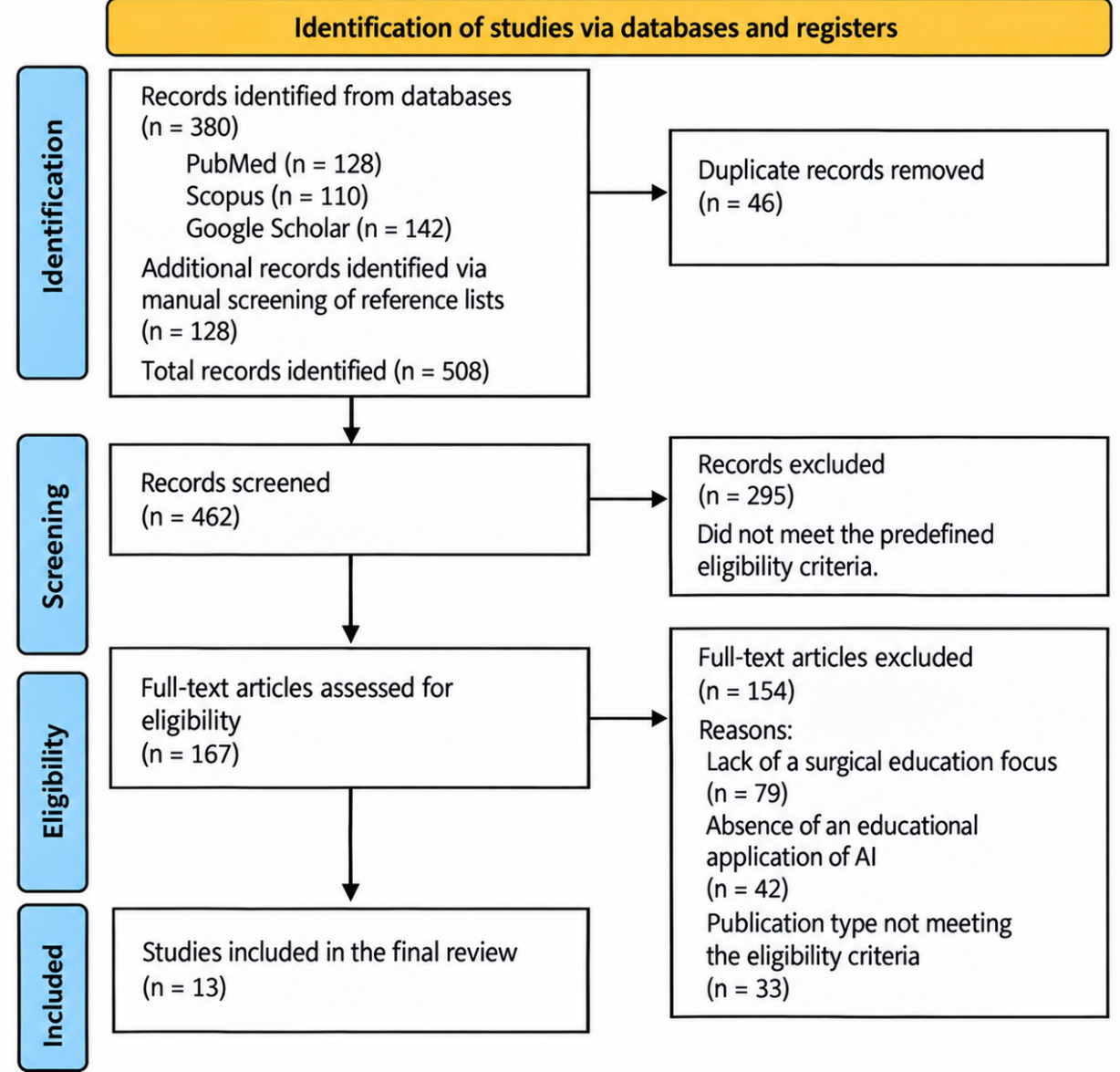
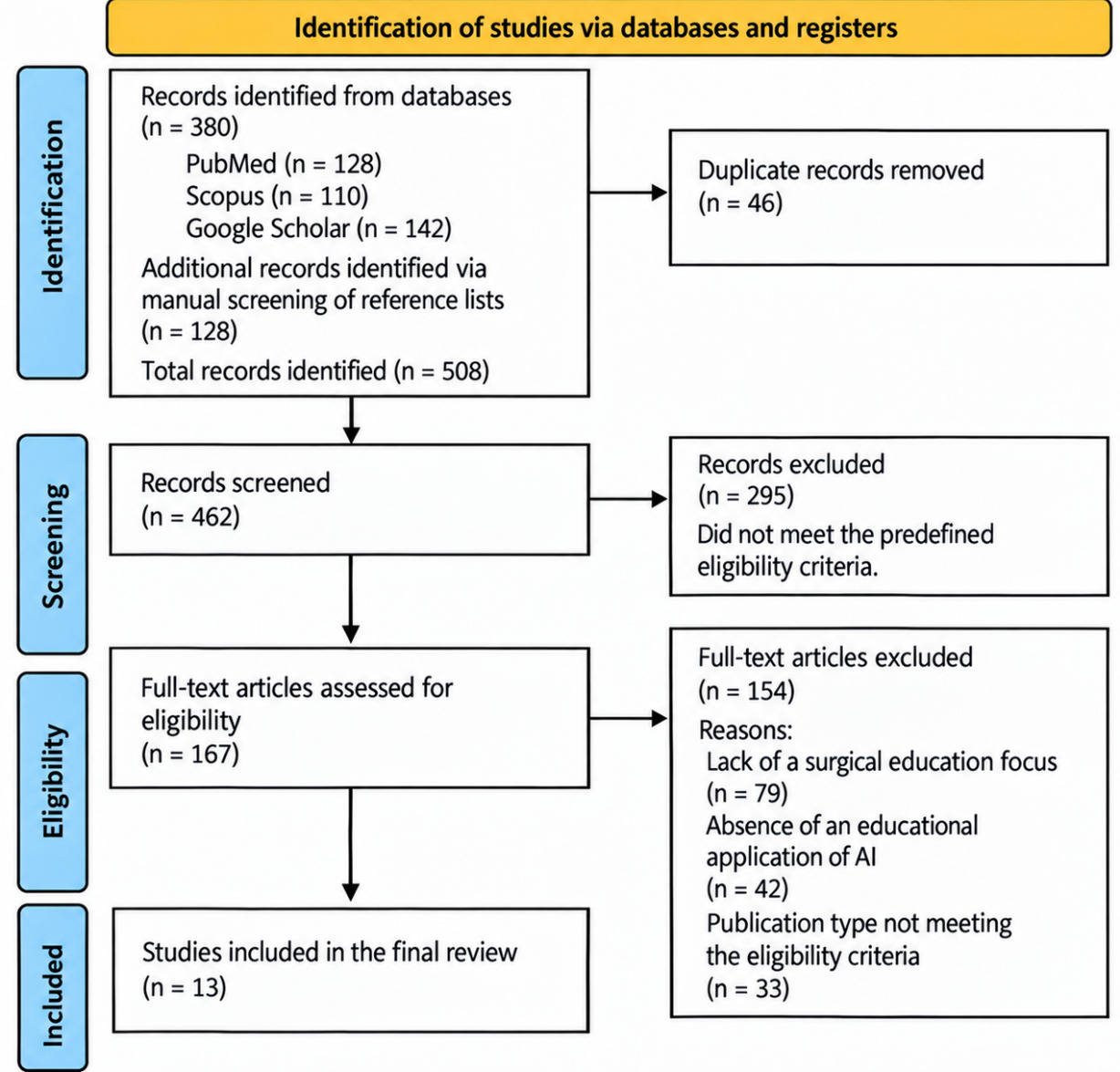
Database searches yielded 380 records. An additional 128 articles were identified through backward citation screening of reference lists, thus yielding a total of 508 records. Forty-six duplicates were removed; thus, 462 articles underwent title and abstract screening. A total of 295 articles did not meet the predefined eligibility criteria. The remaining 167 articles underwent dual full-text screening; 154 articles were excluded. Ultimately, 13 publications were included for analysis. Two reviewers (JK and IE) independently screened records and assessed the full texts. Disagreements were resolved by consensus. The following data were extracted using a standardized sheet: publication characteristics, geographic classification, evidentiary role, educational application, ethical considerations, and recommendations. The Preferred Reporting Items for Systematic reviews and Meta-Analyses (PRISMA) flow chart for the study selection process is shown in Figure 1.
Thematic analysis
The 13 publications were independently reviewed and thematically coded, with disagreements resolved by consensus. Additional references were used to support background information and contextual interpretation. Publications were classified based on evidentiary role as follows: education-focused, contextual/technical, or background/conceptual. Education-focused publications evaluated AI-enabled surgical education, learning, and assessment. Contextual/technical publications included relevant clinical or technical AI publications that informed the current review without directly evaluating an educational application. Background/conceptual publications provided general perspectives on the use of AI in surgery without a direct educational focus. The classification for each publication is shown in Supplementary Table 1. Following thematic analysis, findings were grouped as follows:
-
Current AI Applications: Publications that described the use of AI-enabled assessments, simulation and adaptive feedback, personalized learning and educational chatbots in surgical education,
-
Ethical and Regulatory Considerations: Publications that described data privacy, protection, safety, transparency, accountability, human oversight, and regulations or any general surgical ethical concerns in AI-enabled surgical education,
-
Recommendations and Operationalization Strategies: Publications included recommendations from the authors.
Publications could contribute to more than one theme. A theme was coded “Yes” when the publication substantively addressed the corresponding topic and “No” otherwise. The specific publications under each theme are shown in Supplementary Table 2. No meta-analysis or formal risk of bias assessment was performed.
Ethical considerations
This narrative review was based exclusively on previously published literature. No individual patient or trainee-level data were collected. Therefore, ethical approval and informed consent were not required in accordance with institutional and international research ethics guidelines.
Results
Study characteristics
Thirteen publications were included for analysis. Nine were reviews, 2 were original research consensus studies, one was an innovation report, and one was a correspondence. Based on the geographical scope of populations and settings examined, 3 publications were classified as HIC, 1 publication was classified as mixed-setting, and 9 publications were classified as international/unspecified. None of the publications were classified as LMIC-specific. The international/unspecified category was used for publications that did not establish the income-setting scope of the evidence reviewed. These classifications describe the scope of the evidence rather than the authors’ affiliations and do not indicate a direct evaluation of AI-enabled surgical education in each setting. Madani et al6 used a surgical-video dataset including data from 37 countries, including HIC and LMIC settings, but examined intraoperative anatomical recognition rather than educational outcomes. The characteristics of the included studies are presented in Supplementary Table 1.
Evidentiary role
Eleven publications were classified as having education-focused evidence because they directly addressed applications of AI in surgical education, as shown in Supplementary Table 1. One publication6 was classified as having contextual evidence. One publication1 was classified as having background/conceptual evidence. Findings on educational applications were interpreted primarily based on education-focused literature, while contextual and background publications informed assessment and implementation considerations.
Theme 1: Current applications of AI in surgical education
Eleven publications examined the current applications of AI in surgical education (Supplementary Tables 1 and 2). These publications described AI-enabled assessments, adaptive feedback, personalized learning and educational chatbots. Azhar et al7 described the emerging applications of AI in surgical education, particularly technical skills assessments, while emphasizing the need for appropriate validation before integrating AI into training programmes. Pakkasjärvi et al8 described the potential applications of AI in surgical education, and Ogbonnaya et al9 synthesized evidence on AI-enabled laparoscopic skills training.
Vedula et al10 identified AI-enabled metrics for assessing surgical performance. Lee and Wong11 and Raghavan et al12 described the potential use of AI to support personalized learning experiences by offering performance assessments and individualized feedback. Sathe et al13 described the development of custom AI chatbots for surgical education. These findings may inform the future development of AI-enabled surgical education in LMICs but were not interpreted as evidence that these approaches are effective in LMIC settings.
Theme 2: Ethical and regulatory considerations
Some of the included publications addressed ethical and regulatory concerns, as summarized in Supplementary Tables 1 and 2. Reported concerns included algorithmic bias, lack of regulations, transparency, accountability and inequitable access to digital technologies. Satapathy et al2 emphasized privacy, bias, regulation, and resource constraints, while Vedula et al10 identified validation, privacy, and human oversight as important considerations for AI-enabled assessments. Sathe et al13 identified accuracy, hallucination, safety, and content validation as important considerations for educational chatbots. Madani et al6 highlighted limitations related to the reliability and generalizability of AI-based surgical anatomy recognition, underscoring the need for further validation before clinical application. However, these technical limitations should be carefully interpreted not as an explicit discussion of ethical or regulatory concerns (Supplementary Table 1). Furthermore, while these findings reveal ethical and regulatory issues that may be relevant to implementation in LMICs, LMIC-specific evidence supporting these concerns was limited.
Theme 3: Recommendations
Eleven publications provided recommendations concerning implementation, validation, integration with existing surgical curricula, human oversight, and further research into educational and clinical outcomes (Supplementary Table 2).
Vedula et al10 provided multidisciplinary consensus-based requirements for AI-enabled assessment and performance metrics. Sathe et al13 identified validation and safety requirements for educational chatbots. Ogbonnaya et al9 highlighted the need for stronger evidence on sustained skill acquisition. Leon et al14 and Raghavan et al12 emphasized that AI should complement rather than replace human supervision and that implementation requires rigorous validation and responsible governance. Azhar et al7 emphasized the need for appropriate development, evaluation and validation of AI applications before integrating them into surgical education. These recommendations were drawn from HICs, mixed settings, and international/unspecified settings. No included publication could be confidently classified as LMIC-specific based on its reported evidence scope.
Discussion
Current applications of AI in surgical education
Surgical education is currently undergoing a shift from the traditional apprenticeship-Halstedian model to an increased emphasis on individual learning, efficiency, and measurable competency.12 AI is increasingly being explored as a tool for surgical skills acquisition and assessment.12 However, none of the publications included in this review were classified as LMIC-specific. Findings from HICs, mixed settings and international/unspecified settings should be considered contextual rather than directly transferable to surgical education in LMICs.
Assessment and individualized feedback
AI may support individualized surgical education by analyzing performance data (eg, procedural video, instrument motion, task duration, selected technical errors) to generate performance indicators.7,10,15 These indicators could inform individualized practice, identify persistent technical deficits, and support subsequent faculty feedback or progression decisions.8 AI-enabled feedback may be provided directly to learners or used by educators as an adjunct to conventional assessment and coaching. However, evidence for this pathway remains nascent, and the validity and reliability of AI-derived assessments vary across tasks and settings.10,15
Madani et al.6 evaluated computer-vision models for identifying surgical anatomy and safe and dangerous dissection zones during laparoscopic cholecystectomy. Their study provides contextual technical evidence for intraoperative guidance rather than evidence of a validated performance assessment for residents or improved educational outcomes. Although such technologies may have future applications in surgical training and feedback, their educational effectiveness requires separate evaluation. In LMICs, the applicability of these approaches requires local validation, appropriate data and infrastructure, and evaluation of learning outcomes.
Personalized learning
AI-enabled personalized learning for surgical training has been examined in HICs.1,11 AI chatbots and adaptive tools can support retrieval practice, individualized study plans and tailored feedback.11,13 Additionally, AI tools can facilitate access to educational information, including current literature and guidelines, although outcomes require verification by trainees and educators. AI tools can process information from medical literature and learner-performance data to generate personalized study plans and tailored study materials, but the accuracy and educational value of such outputs require verification.8 However, evidence of educational benefit with respect to surgical education in LMICs remains limited.
Governance and regulatory frameworks
AI governance and regulatory frameworks in surgery have developed considerably over the last 10 years, especially in HICs.16 However, AI-specific regulatory frameworks remain variably developed across LMICs. Kenya’s Data Protection Act of 2019 provides a general framework for personal data protection but is not specific to AI-enabled surgical education.17 Rwanda’s Artificial Intelligence Policy of 2023 provides a broader framework for national AI governance.18
Responsible implementation may require institutional governance, data protection, human oversight and faculty AI literacy.19 Leslie et al20 discussed broader inequalities and resource, skills and training in health care AI, but this does not establish the preparedness of LMICs’ surgical educators specifically. Institutions should therefore assess local training needs and capacity before designing interventions.
Algorithmic bias
Algorithmic bias occurs when machine learning algorithms produce biased results because of systematic errors.4 Bias often arises when data used to build the machine learning model are not representative of the population it is applied to or the design of the model.14,21 Celi et al22 highlighted the geographical concentration of clinical AI datasets and authorship, including the disproportionate representation of the United States and China in the AI literature and data landscape. Such concentration raises concerns about the representativeness of available datasets and the extent to which AI systems can be externally validated across populations and health care settings. Differences in patient characteristics, disease patterns and clinical environments may affect model performance, underscoring the need for representative data and validation in the populations and settings where these systems are intended to be used.22 Therefore, performance metrics developed in HIC settings should not be assumed to have equivalent validity in surgical training environments in LMICs.
Accountability and human oversight
Surgical education is traditionally rooted in well-defined human roles in hierarchical training structures, with the attending surgeons and training institutions bearing responsibility for clinical decision-making, supervision and trainees’ assessment.3,5 AI systems can complicate these established accountability structures since they can generate recommendations, assessments, and feedback that can influence education and decision-making.2,23
However, the use of AI should not transfer professional accountability to the technology. Instead, accountability should be distributed according to stakeholder roles. Developers should ensure appropriate system design, validation, transparency and disclosure of limitations; institutions should provide governance, implementation and monitoring; and educators should maintain human oversight and critically interpret AI-enabled outputs.23 Trainees should also critically appraise AI-enabled information and avoid relying on automated outputs without appropriate professional judgement.
Ethical integration
AI integration into surgical education may have potential benefits but should preserve human oversight and professional accountability.2 AI systems can process information and give instant feedback, but they do not independently provide the professional judgement and contextual oversight supplied by the educators.14
Overreliance on automated outputs may lead to automation bias, reduced critical thinking, and deskilling, while lack of transparency may limit the interpretability of the AI-enabled feedback or output.24,25
Recommendations
The recommendations shown in Table 1 integrate evidence from the literature reviewed herein and represent proposed strategies rather than interventions with established effectiveness in LMICs. Therefore, these recommendations should be contextually assessed and evaluated before implementation.
Limitations and mitigations
The limitations and mitigations of this review are provided in Table 2.
Strengths
This review incorporates recent literature on the use of AI in surgical education and identifies key issues concerning evidence gaps, governance, data protection, algorithmic bias, accountability, and regulatory gaps. These findings may provide insight into the ongoing development of AI governance frameworks that LMICs may need during the formulation of such systems.
Conclusion
AI has the potential to complement surgical education through assessments, simulation, personalized learning, and feedback, but the publications examined herein do not establish the effectiveness of AI-enabled surgical education in LMIC settings. Evidence from HICs, mixed settings and international/unspecified settings provides contextual insights rather than proof of local transferability. Proposed implementation should be assessed with local educational, institutional and regulatory contexts, with attention to governance, data protection, human oversight and faculty AI literacy. Future studies in LMICs should evaluate validity, feasibility, acceptability, cost and educational outcomes.
Ethical Approval
Ethical approval was not required in accordance with institutional and international research ethics guidelines.
Informed Consent
Informed consent was not required in accordance with institutional and international research ethics guidelines.
Data Availability
All data analysed in the research are included in the article and supplementary files.
Conflict of Interest
None.
Funding
None.