Introduction
Priapism is a urological disorder with persistent and uncontrolled erections without sexual purpose. It is classified as ischemic (low flow), non-ischemic (high flow), or stuttering (recurrent or intermittent), with ischemic priapism being the most frequent form of priapism, with sickle cell disease being one of the most important risk factors for its development; studies have reported prevalence rates between 30%–40% among individuals with sickle cell disease. Prevalence of sickle cell disease (SCD) across African countries ranges between 1%–3% and contributes up to 7%–16% of under-five mortality .1 Sub-Saharan Africa bears more than 70% of the global SCD burden,2 suggestive of priapism being likely significant in Zambia. The cumulative incidence of priapism reaches 60% by age 40 .3 A study conducted in the United Kingdom and Nigeria reported an incidence of priapism of approximately 35% among patients with sickle cell anemia4 in comparison from Jamaican studies, the contrast of incidence rate is higher at 41.6%.5 Currently, there are no published Zambian data quantifying the incidence of priapism in SCD, highlighting a critical knowledge gap.
Several factors have been identified as predictors of priapism among patients with SCD. The use of hydroxyurea in patients’ management therapy has been investigated for its association with priapism. In Uganda, approximately 33% of patients with SCD are currently receiving hydroxyurea therapy.6 In addition, studies have reported a significant association between haemoglobin levels and the incidence of priapism.7 Sexual activity has also been identified as one of the most frequently reported triggers, followed by fever and dehydration.4 Other factors described in the literature include infections, malaria exposure, cold weather and physiological stress.
Although no published studies exist in Zambia on incidence, risk factors, and triggers of priapism, this study will formally investigate these factors. This study focuses specifically on ischemic priapism, which is the most common form of priapism, while nonischemic (high flow) priapism is considerably less common.
Methods
The study adopted a descriptive cross-sectional design integrating both quantitative and qualitative data collection techniques. The study was conducted at Roan Antelope General Hospital, located in the Luanshya District of Zambia’s Copperbelt Province. The hospital is a second level referral facility. Data collection was conducted over a period of 15 weeks.
To broaden the study’s reach, recruitment was expanded to community settings across Luanshya and surrounding areas. Community-based recruitment involved collaboration with two SCD organisations: LukumoNtambo Foundation, founded in 2018, and Hope 4 Sickle Cell Foundation, founded in 2026 by Ms Mwanza Changala. The organisations assisted with dissemination of study information and recruitment of eligible participants through their respective SCD support networks. Study information was also disseminated through WhatsApp group chats and community advocates to inform and invite eligible participants.
The study population included male individuals diagnosed with SCD aged >5 years old. The sample size for this study was determined using Cochran’s formula, which gave the size target of 350 participants; however, the study recruited a target of 100 participants due to infrequent occurrence of priapism among patients with SCD. A structured questionnaire was developed in accordance with the study objectives and reviewed by the research supervisor to assess the relevance and clarity of the questions. The questionnaire was administered to participants, with questions explained orally in local language where necessary to ensure the language barrier was addressed. The questionnaire captured information on socio-demographic characteristics: place of birth, place of residence; clinical history: infections, diarrhoea, herbal medication, malaria episodes; lifestyle factors: sexual activity, travel history, stress; and triggers of priapism among individuals living with SCD.
Participants attending Roan Antelope General Hospital outpatient clinics and/or admitted to the hospital completed paper-based questionnaires under researcher supervision. Researcher supervision enabled clarification of questions, ensured completeness of responses, and ensured verification of clinical information from patient records, though some records were not documented in the patient file. For hospital-based participants, information on SCD diagnosis, genotype, and haemoglobin levels were physically verified against patients’ medical records and available laboratory results from the hospital lab. Where relevant information was not documented in the patient file or lab records, participant self-report was used. To extend recruitment beyond the hospital setting, an electronic version of the questionnaire was administered to community-recruited participants. For these participants, information regarding SCD diagnosis, genotype, and other clinical characteristics was obtained through self-report where supporting medical or lab documentation was unavailable.
Data were entered, coded, cleaned, and analysed using Statistical Package for the Social Sciences. Categorical variables were summarized using frequencies and percentages. Associations between socio-demographic, clinical characteristics, and history of priapism were assessed using the chi-square test of independence. The outcome variable was history of priapism, categorized as priapism or no priapism. Explanatory variables included sickle cell genotype, haemoglobin level, frequency of vaso-occlusive crises (VOC), hydroxyurea use, and age category. Statistical significance was assessed at the 5% level, with a P value <0.05 considered statistically significant. The analysis was univariate given the achieved sample size and the study focusing on examining associations between individual variables and history of priapism.
We included male patients aged >5 years with a confirmed diagnosis of SCD (e.g., HbSS, HbSC, HbSβ-thalassemia) who provided informed consent (and assent where applicable) were included. Patients with a history of priapism from non-SCD causes (e.g., spinal cord injury, trauma, leukaemia, or drug-induced), those unwilling or unable to provide informed consent, and those lost to follow-up before study completion were excluded. The study was potentially susceptible to recall bias due to information on priapism episodes being based on self-reports. The sensitive and stigmatizing nature of priapism may have contributed to social bias and underreporting of episodes. Additionally, the way questions were asked or interpreted during data collection may have influenced participant responses.
Ethical approval and necessary administrative approvals for the study were obtained from University of Lusaka ethical committee, National Health Research Authority (NHRA) in Zambia and Superintendent of Roan Antelope General Hospital.
Results
Most respondents were younger than 24 years, accounting for 66% of the study population. Most participants were born and/or living in Copperbelt, accounting for 68%. Regarding education attainment, 44% of participants had secondary education as their highest level of education. Among caregivers, 45.8% had attained secondary level education. (Table 1)
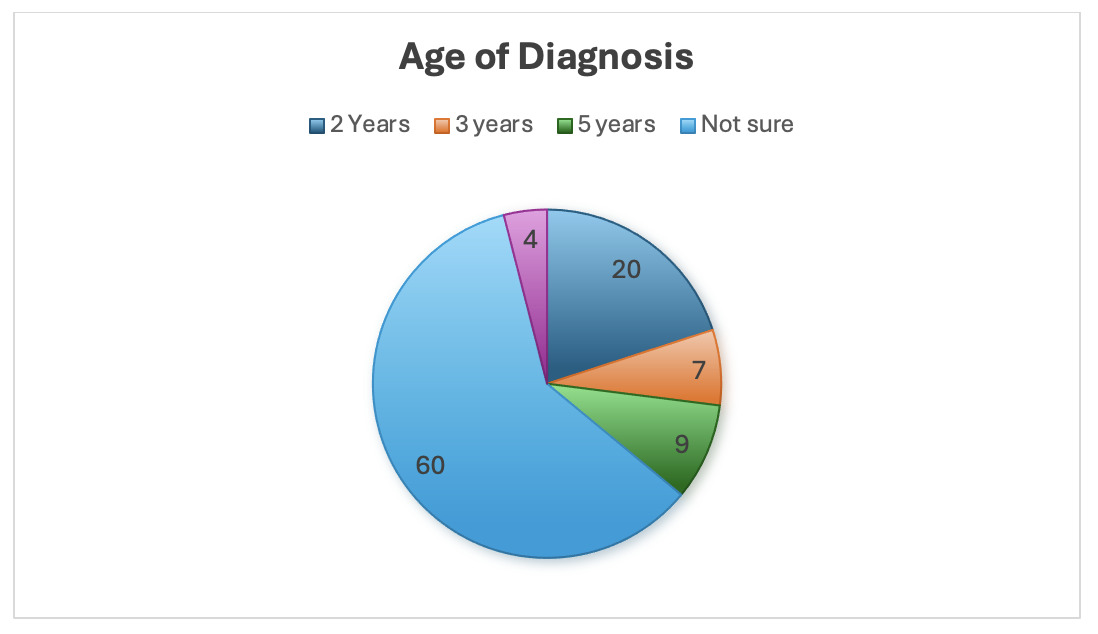
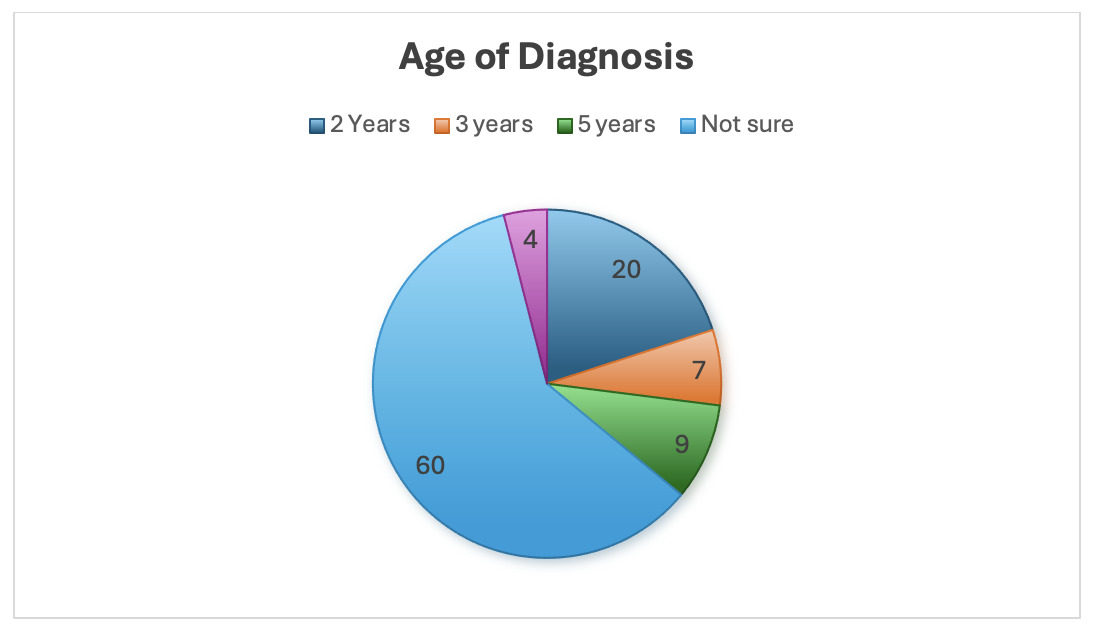
The majority of respondents (60%) were unable to recall their age at diagnosis. Among those who recalled, 20% reported being diagnosed at 2 years, 9% at 5 years, and 7% at 3 years, while only 4% were diagnosed during infancy. (Figure 1)
A total of 54 participants experienced priapism. Among participants with the HbSS genotype, 51.8% reported having experienced priapism at some point in their life. Similarly, 50% of participants with low Hb experienced priapism. Participants with a high VOC frequency accounted for 53.7% of those who reported a history of priapism. Absence of hydroxyurea use was reported by 64.8% while hydroxyurea use was reported by 35.2% of participants. (Table 2)
Out of the 54 participants who had ever experienced priapism, the majority (70.4%) reported stuttering priapism.8 Ischemic priapism lasting more than four hours was reported by 18.5% of participants, while mixed presentations accounted for 11.1% of cases. No cases of nonischemic priapism were reported. (Table 3)
Fever and infections were the most frequently reported triggers (59.3%), followed by malaria (51.9%), with dehydration (44.4%) and diarrhoea (33.3%). Emotional and academic stress were reported by 40.7% of participants, while cold exposure reported 29.6%. Herbal medication use was reported by 18.5% of participants, and sexual activity triggered episodes in 14.8% of individuals, predominantly among adult participants. (Table 4)
Discussion
Incidence
In this study, an incidence of 54% of SCD patients reported at least one episode of priapism during their lifetime. The majority of participants were aged 24 years, which is comparable to findings from a study conducted in Nigeria, where the mean age of participants was 25.4 years.9 This observed incidence in the present study is also within the range reported internationally, where priapism has been documented to range from approximately 29%–42% of males with SCD.4 The relatively high proportion observed in the current study may reflect differences in study populations, health care-seeking behavior, and study methodology.
SCD predominantly affects populations of African ancestry. Recent studies noted ethnicity to be a factor to priapism incidence in sickle cell. A study noted higher incidence rates in African, Asian, and Hispanic patients compared to Caucasians.10,11 Studies show greatest disease burden occurring in sub-Saharan Africa, where limitations in health care resources and financial barriers may influence access to care. These factors may contribute to under-recognition and underreporting of priapism, particularly when episodes are managed at home or do not result in presentation to health care facility. In addition, young men may be reluctant to disclose symptoms related to sexual and genitourinary health because of stigma or discomfort. This is suggestive of previous underestimations across Africa that could have resulted from clinic-based sampling only. However, this interpretation should be accounted for differences between studies.
Findings in Figure 1 are suggestive of possibilities that participants may have experienced periods of unmanaged episodes of SCD during early childhood. Contrasting literature argues age as a determinant factor for incidence, trigger, and risk factor for priapism. One study presented a cumulative incidence of almost 60% of the population had experienced priapism by the age of 40 years old while another study argued no significant differences in median age or priapism duration were observed between Hispanic/Latino and non-Hispanic/Latino patients.3,10 With the study population, younger children (5–12 years) experienced fewer episodes of priapism. This is within consideration of caregivers reporting the episodes and noting their education level (Table 1), which may limit awareness of priapism signs. Severe episodes are uncommon in pediatric SCD patients; sexual function in young and prepubertal patients appears to be much better than for adults.12 Therefore, we cannot conclude that younger children experience fewer priapism episodes. With young adults and adults having higher rates of priapism, this can be due to pubertal hormonal changes, increased sexual activity, and exposure to stressors.4
Risk factors
In Zambia, place of birth and residential play several roles in predicators of priapism. For instance, participants from Luapula and Northern province reported higher incidence due to predisposition of the HbSS/HbSC allele. With Eastern, Luapula, and Northern province being high malaria regions, participants from or residing in these regions are prone to increased risk of haemolysis (Table 1).
In regard to Table 2, Hydroxyurea nonuse may be relevant to the occurrence of priapism in patients with SCD. Thirty-five (64.8%) of the 54 participants with a history of priapism had never used hydroxyurea, compared to the 42 (91.3%) of the 46 participants without a history of priapism. The proportion of participants who had never used hydroxyurea was lower among those with a history of priapism than among those without priapism. Therefore, these findings do not demonstrate that hydroxyurea nonuse was associated with an increased occurrence of priapism in this study. The relatively low level of adherence may reflect barriers at the individual, facility, and community levels.13 Inadequate adherence to disease-modifying and preventive therapy may contribute to poorer disease control and potentially increase the occurrence of SCD-related complications. However, the cross-sectional design of this study limits the ability to establish a causal relationship between medication adherence and priapism.
Priapism occurrence was associated with low haemoglobin (Hb), further suggesting a relationship between disease severity and priapism. Priapism was more reported among participants with lower Hb concentrations, with 50% of participants with Hb <10g/dL being a risk factor to priapism occurrence. This finding is biologically plausible because increased haemolysis and anemia may contribute to nitric oxide depletion, endothelial dysfunction, and abnormal penile vascular regulation. In addition, previous studies reported differences in other hematological parameters, including white blood cell count (P = 0.010), platelet count (P = 0.001), reticulocyte count (P < 0.001), mean corpuscular volume (MCV) (P < 0.001), and mean corpuscular haemoglobin (MCH) (P < 0.001).14 The studies also demonstrated differences between participants. These should be described as observed differences rather than established predicators.
Triggers
Diarrhoea (33.3%) and travel history (25.9%) from the past 12 months also precipitated to the risk factor of priapism episode (Table 4), Diarrhoea may contribute to dehydration, which can increase blood viscosity and potentially promote sickling and vascular obstruction. Travel to malaria-endemic areas may increase exposure to infections/fever that can precipitate haemolysis and physiological stress in individuals with SCD. These findings highlight the importance of counselling, based on a history of the prior 12 months, men with at least 3 preceding priapism events should be counseled on their increased risk of priapism for at least the next 3 months.15
The use of herbal medication was reported by 18.5% of the participants. This finding may reflect the continued use of complementary approaches to health care among individuals living with SCD, which is a common reliance across African studies.16 Further investigation is required to determine whether specific herbal preparations influence the frequency, duration, or severity of priapism episodes.
Limitations
This study has several limitations. It focused specifically on ischemic (low flow) priapism, as nonischemic (high flow) priapism was rare among participants. The study relied on self-reported data, which may be subject to recall bias; despite expanding recruitment, participants may not fully represent all individuals living with SCD in Zambia. Some community participants could not provide complete clinical data, limiting the analysis. Priapism is a highly sensitive and stigmatized issue, often underreported even among eligible participants, and cultural and psychosocial barriers reduce willingness to disclose episodes, affecting the number of respondents willing to participate in the study. Finally, the study was limited by the use of univariate statistical analysis.
Conclusion
54% of males with sickle cell experience priapism across both paediatrics and adult age groups. The findings confirm that HbSS genotype, chronic haemolysis, and VOC remain fundamental drivers of priapism; however in sub-Saharan African context, these biological vulnerabilities are dramatically amplified by systemic and environmental factors.
Ethical Approval
Ethical approval and necessary administrative approvals for the study were obtained from University of Lusaka ethical committee, National Health Research Authority (NHRA) in Zambia and Superintendent of Roan Antelope General Hospital
Consent
For participants below 18 years, written informed consent was obtained from their parents or legal guardians. For adult participants, written informed consent was obtained.
Data Availability
The data supporting the findings of this study are available from the corresponding author upon reasonable request.
Conflict of Interest
None
Funding
None