Introduction
Musculoskeletal trauma is a leading and rapidly growing contributor to disability worldwide, and a disproportionate burden is borne by patients in low- and middle-income countries (LMICs).1 Across sub-Saharan Africa, road traffic injuries, falls, and interpersonal violence generate a high volume of complex pathologies that frequently present late, after attempted traditional bonesetting or with substantial soft-tissue compromise. Definitive surgical care for this burden remains inaccessible to many patients, largely because the specialist orthopedic workforce in East, Central, and Southern Africa remains critically undersized.2
Education is among the most durable and important investments available to address this gap.3 However, conventional forms of continuing medical education in surgery, such as international fellowships, in-person courses, and society meetings, are resource-intensive, geographically constrained, and rarely affordable at scale for surgeons practicing in resource-limited environments.4,5 Even where local training programs exist, opportunities for subspecialty case discussion, peer-to-peer feedback, and exposure to international expertise can be limited.6
Digital platforms have emerged as a promising adjunct, with examples including the Institute for Global Orthopedics and Traumatology Learning Portal,7 the AO Surgery Reference,8 the United Nations Global Surgery Learning Hub (SURGhub),9 and country-specific initiatives such as the Haitian State Hospital Orthopedic Grand Rounds.10 In parallel, growing evidence supports the use of virtual conferences, podcasts, and case-based teleconferencing as effective complements to traditional surgical training.11 However, content optimized for high-resource environments—predicated on the routine availability of advanced imaging, modern implants, and intensive perioperative care—may have limited applications for surgeons managing patients with delayed presentation, contaminated open fractures, and limited implant inventories.12 Few platforms are intentionally designed for resource-limited environments, and rigorous descriptions of their reach, engagement, and educational impact remain limited.
The Harvard Global Orthopedics Collaborative (HGOC), established in 2016, is an academic group dedicated to improving access to essential trauma and orthopedic care for patients in resource-limited settings. SONA Global, a partner non-profit organization established in 2022, advances this mission through affordable device innovation and free virtual education. Building on the success of the early virtual education conferences and the affiliated online community and video library described in previous work,13 our organization developed SONA Global Academy (SGA) as an integrated, free, open access digital learning platform. SGA combines a curated multilingual library of prerecorded expert lectures and reading materials with structured, live, and case-based virtual conferences delivered in a flipped-classroom format.
The objectives of this study were to: (1) describe the design and implementation of SONA Global Academy (SGA) as a digital education platform for surgeons in resource-limited settings; (2) characterize learner engagement and reach across the 2025 conference cycle; and (3) evaluate participant-reported educational impact, which includes knowledge gain, anticipated clinical practice change, and qualitative feedback.
Methods
We conducted a descriptive program evaluation of SGA and its 2025 virtual education conference cycle, drawing on routinely collected post-session survey data and platform engagement analytics.
Platform description
SGA is a free open access digital education platform developed by SONA Global in partnership with HGOC. The platform integrates three components: (1) a curated library of prerecorded expert lectures and open access reading materials organized by subspecialty topic; (2) structured, time-bound virtual education conferences delivered in a flipped-classroom format; and (3) post-conference recordings made openly available for asynchronous learning. Content is available in English, Spanish, and French with translations supported by a multilingual team and Speechify, an AI-assisted dubbing technology. The platform requires no registration fee, login, or institutional affiliation to access. SGA is accessible from any internet-connected device, including smartphones, tablets, and computers with no minimum connectivity requirement for library content. Live sessions are hosted on Zoom, which supports low-bandwidth and audio-only modes, and all sessions are recorded and published on SGA for asynchronous access.
2025 conference curriculum
The 2025 curriculum was comprised of 6 subspecialty series delivered across 15 live sessions: complex lower extremity trauma, global spine surgery, open fracture management, calcaneus fractures, research in global orthopedics, and complex upper limb surgery. The curriculum is defined annually in advance through a participant survey in which prior attendees rank and request topics alongside input from HGOC, SONA Global partner sites, and faculty from collaborating international societies. The resulting emphasis on trauma subspecialties reflects the topics that are most frequently requested by participants practicing in resource-limited settings.
Prerecorded lectures (15–30 minutes each) and curated reading lists were uploaded to the platform one week before each live session. Each live session was 60–90 minutes in duration, hosted on Zoom, and structured around three to five case presentations from surgeons practicing in LMICs, followed by a moderated discussion with international faculty. Sessions were held on Saturdays to accommodate global time zones. Recordings were translated and published open access on the SGA platform within several days of each session.
Participant recruitment
Participants were recruited through SGA and HGOC mailing lists, the Global Orthopedic Education community on WhatsApp, and partner society networks. Registration was free, and there were no eligibility criteria; surgeons, trainees, medical students, and allied health professionals from all countries were welcome to attend. At registration, participants provided their name, email address, gender, professional title, country of practice, hospital setting, specialty, training level, and fellowship status. Registration data were stored on a secure platform and anonymized prior to analysis. Post-session surveys were administered anonymously and were not linked to registration records.
Survey and engagement data
Following each live session, anonymous postsession surveys were administered via Google Forms (Appendix A). The instrument captured training level, attendance, presession curriculum engagement, 5-point Likert ratings of postsession confidence, overall satisfaction, and quality of individual case presentations and live lectures, categorical ratings of self-reported knowledge gain and anticipated practice change, and free-text feedback. Engagement with presession materials was assessed through self-reporting.
Platform engagement was measured from two sources. For each 2025 session, total unique logins were obtained from automated Zoom reports, which count distinct participant accounts, and peak concurrent attendance was recorded from manual observation of the maximum number of simultaneous participants. Because logins are account-based, a participant who rejoins is not recounted, although joining from multiple devices may modestly overcount individuals. Unique logins therefore reflect the cumulative audience reached over a session, whereas peak concurrent attendance reflects sustained simultaneous participation. Cumulative reach and geographic distribution were determined from the SGA registration database, reflecting distinct registered users and their self-reported country of practice rather than results from anonymous web traffic. Since user counts are based on unique registered accounts, repeated visits do not inflate them.
Survey responses were analyzed using Python with the pandas library. Descriptive statistics were computed for all numerical and categorical variables. Free-text responses were grouped thematically using inductive content analysis. Analyses were restricted to descriptive statistics. Because surveys were anonymous and could not be linked across sessions or to individual registration records, and because response rates were modest and self-selected, inferential comparisons between participant groups, regions, or subspecialty series would be confounded by differential nonresponse and were not performed.
Results
Geographic reach
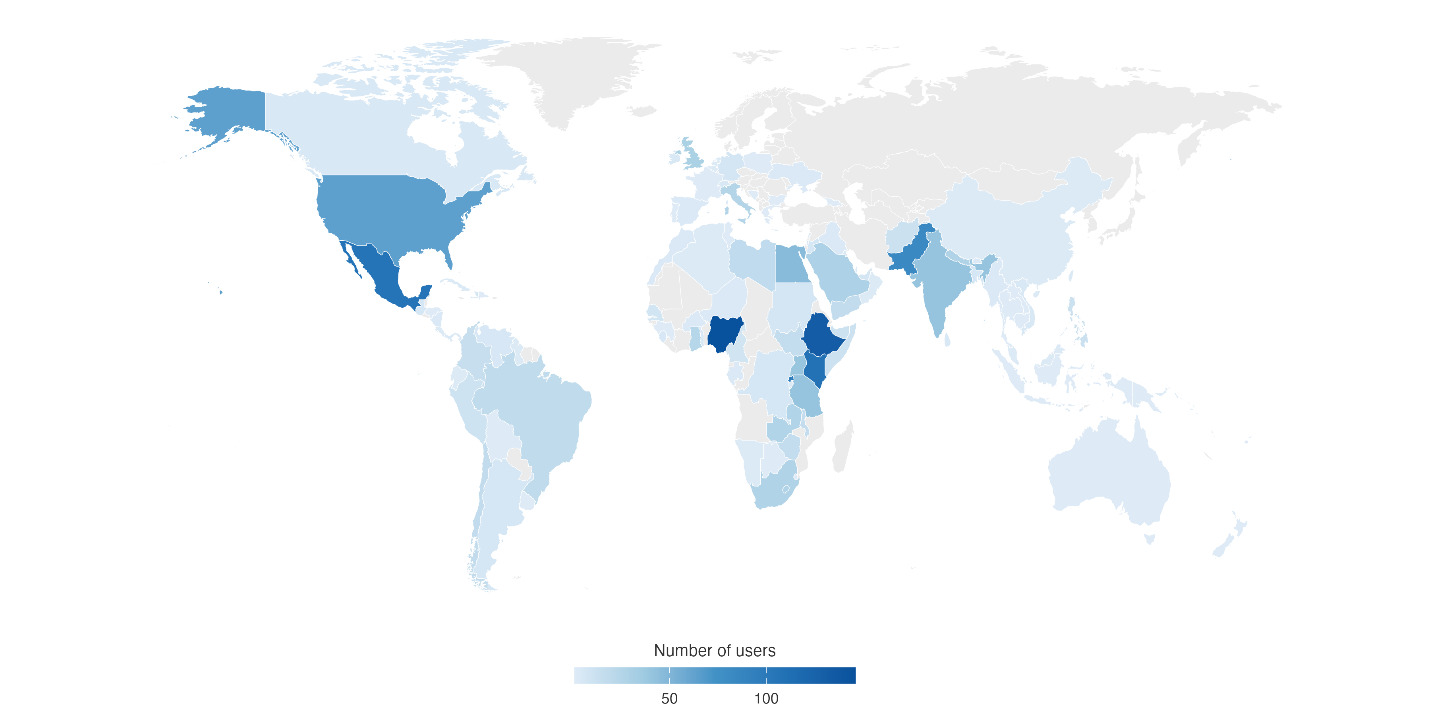
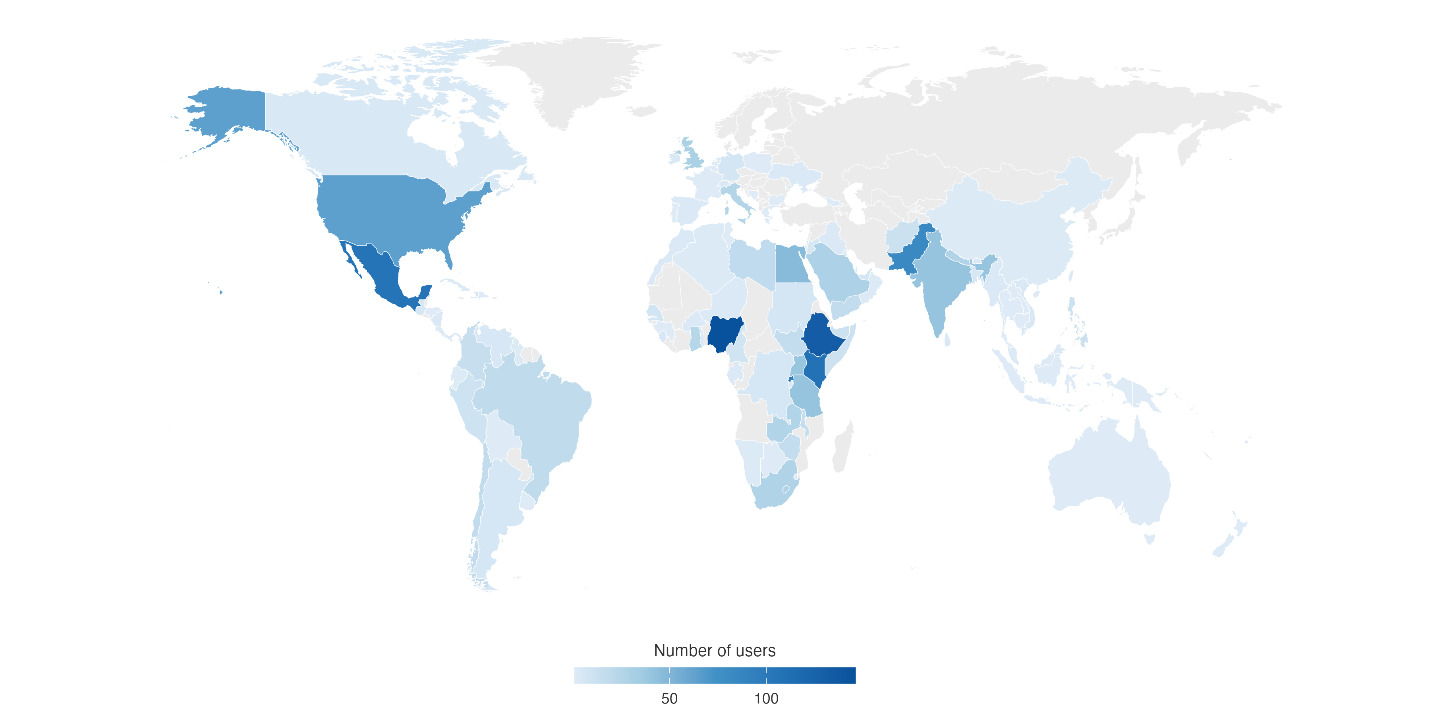
SGA platform analytics identified registered learners across all 6 WHO regions in 110 total countries, with 1495 users having confirmed their country of practice as of July 29, 2026. African learners represented the largest share, accounting for 56.0% (n = 837) of identified users across 35 African countries. The 5 most represented African countries were Nigeria (n = 146, 9.8%), Ethiopia (n = 132, 8.8%), Kenya (n = 109, 7.3%), Rwanda (n = 95, 6.4%), and Egypt (n = 47, 3.1%). A global distribution of platform users is shown in Figure 1.
Participant engagement
Across 15 sessions in 2025, 1444 post-session survey responses were collected. Respondents represented the full spectrum of orthopedic training: attending or consultant surgeons accounted for 38.7% of responses; residents and surgical trainees accounted for 36.5%; medical students accounted for 14.1%; fellows accounted for 7.4%; allied health professionals accounted for 2.5%; and medical officers, general practitioners, and researchers accounted for 0.8%. Engagement with both components of the flipped-classroom model was high: 96.5% of respondents reported attending the live session and 93.2% reported reviewing the presession curriculum or video lectures.
Live session attendance
Across 15 live sessions, 5381 unique logins were recorded, with a mean of 358.7 logins per session (a range of 204–540) and mean peak concurrent attendance of 124.6 per session (a range of 54–178; Table 1). Cumulative audience reach varied across series with the highest mean unique logins in research in global orthopedics (511.5) and complex lower extremity trauma (413.8). The ratio of unique logins to peak concurrent attendance ranged from approximately 2:1 to 9:1 across each series, reflecting both within-session participant turnover and the different methods used to capture the two measures. Unique logins are therefore best interpreted as a measure of cumulative audience reached rather than sustained engagement.
Educational impact
Participant-reported educational impact was high and consistent across all six 2025 conference series, thus demonstrating that the flipped-classroom model performed comparably across anatomically distinct subspecialty trauma topics, specialty-specific elective content, and nonclinical research methodology.
Mean overall satisfaction was 4.56 ± 0.61 of 5, with 94.8% of respondents rating sessions ≥4 and 62.1% giving the session the highest rating. Mean overall satisfaction ranged narrowly across each series, from 4.51 to 4.63. Case presentations were rated highly across faculty and topics, with a mean of 4.54 ± 0.65 across 5255 individual evaluations and 93.7% of session ratings at ≥4. Live lectures and breakout discussions, where included, were rated similarly (mean of 4.57 ± 0.59). Postsession confidence in managing the relevant clinical topic averaged 4.27 ± 0.87 of 5, with 83.1% of respondents rating the session ≥4.
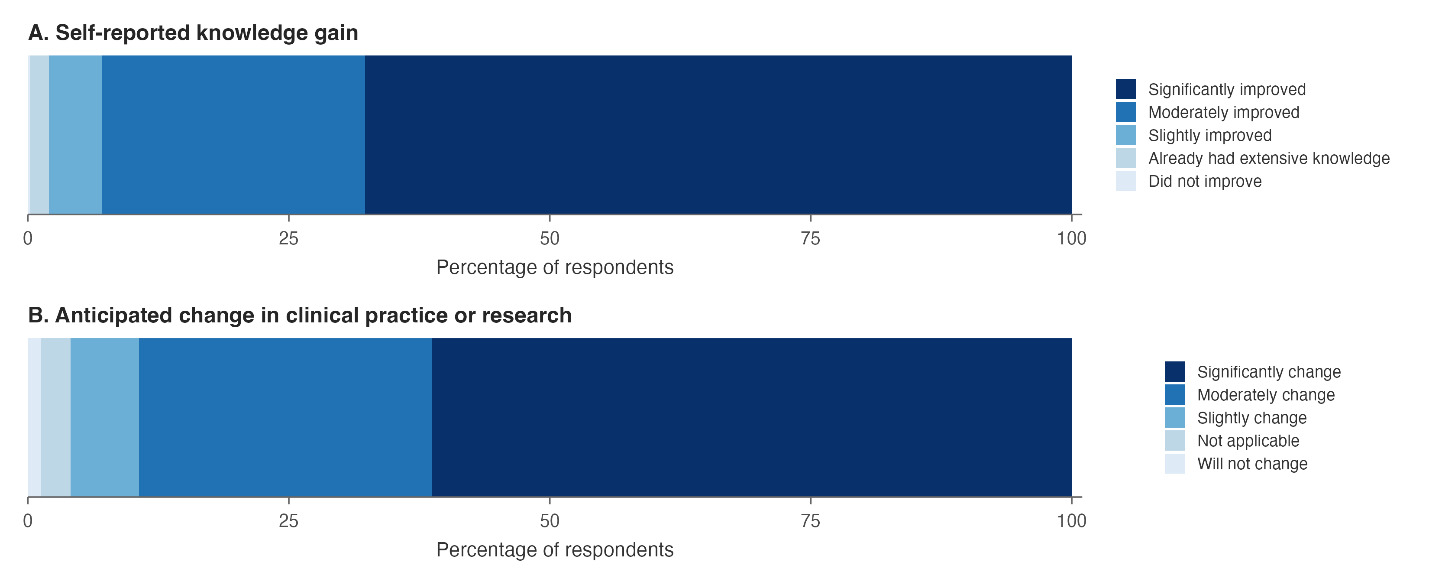
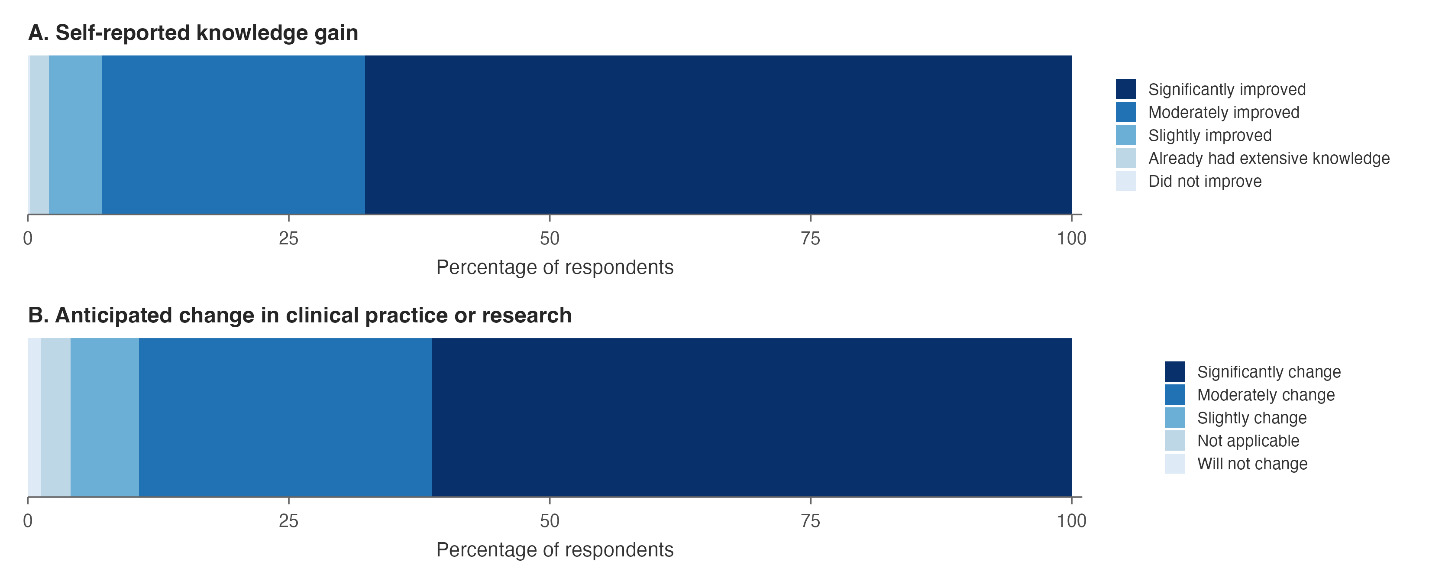
Overall, 93.5% of respondents reported that the session moderately (24.4%) or significantly (69.1%) improved their knowledge of the topic; only 0.3% reported no improvement, and 1.7% reported already having extensive knowledge. Self-reported intent to change clinical practice or research approach was similarly high: 89.8% of respondents reported that the session would moderately (27.1%) or significantly (62.7%) change their practice (Figure 2). Moderate-to-significant knowledge gain ranged from 89.8% (global spine surgery, n = 274) to 97.0% (complex upper limb surgery, n = 397), with calcaneus fractures (96.5%, n = 85), open fracture management (96.4%, n = 84), research in global orthopedics (95.6%, n = 68), and complex lower extremity trauma (91.6%, n = 536) falling within this range. Anticipated practice or research change followed a similar pattern across each series, ranging from 86.1% to 97.1% (Table 2).
Qualitative themes
A total of 643 free-text responses described how clinical practice or research would be influenced. Five themes emerged (Table 3): (1) adoption of context-appropriate techniques (e.g., staged management of high-energy pilon fractures, cross-leg flaps, the shoelace technique, SIGN intramedullary nailing, external fixator constructs); (2) revision of clinical algorithms (e.g., treating tongue-type calcaneal fractures as surgical emergencies, prioritizing early soft-tissue coverage in Gustilo IIIB injuries, and adopting staged approaches to high-energy articular injuries); (3) improved preoperative evaluation and planning (e.g., imaging interpretation, classification-driven decision-making, and pre-operative templating); (4) intent to seek multidisciplinary collaboration between spine, pelvic-acetabular, and orthoplastic teams; and (5) research capability building (e.g., Population Intervention Comparison Outcome Time (PICOT)-structured question development, study design, and literature review practice). Several respondents emphasized the value of learning from surgeons working in similar resource-limited settings, which reinforces the importance of local faculty representation.
Discussion
Strengths
In this descriptive program evaluation, we describe the design, reach, and learner-reported impact of SGA, a free, open access, and multilingual digital education platform developed in partnership with HGOC for orthopedic surgeons in resource-limited settings. Across 15 live sessions delivered during the 2025 conference cycle, SGA engaged learners from 125 countries with 56.0% of identified platform users based in Africa, and the largest national populations came from Nigeria, Ethiopia, Kenya, Egypt, and Rwanda. Across 1444 postsession survey responses, 93.5% of participants reported moderate-to-significant knowledge gain and 89.8% reported anticipated moderate-to-significant change in clinical practice with consistently high satisfaction (mean 4.56 of 5) across all six conference series.
These findings build on a previously described program of nine virtual education conferences delivered between 2021 and 2024 by HGOC and SONA Global, which engaged 2957 unique registrants from 92 countries and established the feasibility of a flipped-classroom, case-based model for international orthopedic education.13 The 2025 cohort presented here demonstrates that the underlying model has continued to scale: cumulative geographic reach expanded from 92 to 125 countries; the curated lecture library grew from 51 to more than 400 recorded lectures in English, Spanish, and French; and the curriculum broadened from a small number of broad clinical areas to six structured subspecialty series. The flipped-classroom format continued to produce satisfaction and case presentation ratings nearly identical to those of the prior cycle (4.56 vs 4.62 out of 5 for satisfaction; 4.54 vs 4.55 out of 5 for case presentations),13 which support the consistency of the educational model as breadth and reach have expanded. A complementary hybrid in-person and virtual workshop delivered in Kigali, Rwanda in 2025 demonstrated that the same model adapts to live skills training with substantial improvements in self-reported confidence in open fracture management.14 These results are consistent with prior evaluations of virtual orthopedic continuing medical education in low-resource settings, which have demonstrated short-term knowledge gains following bilingual virtual sessions,15 and with broader reviews supporting e-learning and case-based teleconferencing as adjuncts to traditional surgical training in resource-limited contexts.11,12
Several features of the SGA 2025 cohort warrant emphasis. The platform reached substantial scale, with 5381 unique Zoom logins recorded across 15 sessions. The identified user population is concentrated in countries served by the College of Surgeons of East, Central and Southern Africa (COSECSA) and partner regional societies, aligning SGA’s reach with the regions of greatest unmet orthopedic surgical need.2 The flipped-classroom design performed consistently across clinical subspecialty topics and research domains with moderate-to-significant knowledge gain ranging only from 89.8% in global spine surgery to 97.0% in complex upper limb surgery, which is consistent with adult learning theory that emphasizes scaffolded engagement with foundational content prior to active application.16 Free-text responses described concrete adoption of context-appropriate techniques, including the shoelace technique for fasciotomy closure, SIGN intramedullary nailing, and cross-leg flaps for soft-tissue coverage, alongside explicit revisions to clinical algorithms such as those treating tongue-type calcaneal fractures as surgical emergencies and prioritizing early soft-tissue coverage in Gustilo IIIB injuries, supporting that case-based discussion among surgeons in similar settings can translate into meaningful changes in clinical decision-making.
Several challenges shaped the implementation of SGA and informed its ongoing development. Unreliable connectivity and limited bandwidth in many participant settings constrained live participation. To keep content accessible regardless of local infrastructure, every session was recorded and published open access for asynchronous viewing, with low-bandwidth and audio-only connection options available during live sessions. Delivering content across a linguistically diverse audience required multilingual support, which was addressed through a dedicated translation team and AI-assisted dubbing that made lectures and recordings available in English, Spanish, and French. Assembling subspecialty faculty across institutions and time zones required substantial coordination, which was managed by scheduling sessions on weekends and planning the annual curriculum in advance to secure faculty commitment and balance the program across regions. Sustaining engagement beyond initial registration also proved difficult, as reflected in the variable ratio of unique logins to peak concurrent attendance. The flipped-classroom structure, case-based format, and inclusion of presenters from resource-limited settings were intended to maintain relevance and participation. Finally, capturing reliable evaluation data was limited by modest self-selected survey response rates and by occasional duplicate submissions: future cycles will incorporate unique-respondent tracking and platform-level engagement analytics to strengthen data quality.
A free, open access, multilingual digital platform built around a flipped-classroom, case-based model can deliver orthopedic surgical education at a meaningful scale in resource-limited settings, with consistent learner-reported impact across diverse subspecialty domains. SGA is not a substitute for hands-on surgical mentorship or formal residency training, but it can serve as a structured supplement that extends subspecialty exposure regardless of geography or institutional affiliation. Deliberate integration with regional continuing professional development frameworks and explicit mapping of platform content to existing competency frameworks would maximize relevance for the local surgical community.3,6 Prospective longitudinal evaluation of knowledge retention, objective pre- and postsession knowledge assessment, observed behavior change at HGOC partner sites, and linkage of platform engagement to patient-level outcomes would strengthen the evidence base, and blended models combining SGA content with regional in-person workshops and simulation training14 should be evaluated head-to-head against either modality alone.
Limitations
This study has several limitations. Educational impact was assessed exclusively through self-reporting and is therefore subject to social desirability bias, which tends to inflate estimates of knowledge gain and anticipated practice change. The 26.8% survey response rate relative to recorded Zoom logins raises the possibility of selection bias as more engaged learners are likely to be overrepresented; the direction of this bias is again toward more favorable outcomes. Future cycles could reduce this bias by shortening the survey, embedding brief evaluations within the live session rather than afterward, and using automated platform analytics to characterize nonresponders so that respondents can be compared against the full attendee population. Our engagement measures were limited to unique logins and peak concurrent attendance. We did not capture attendance duration, watch time, retention curves, or in-session interactions such as chats or question activity, which would more directly characterize the depth and persistence of participation, and incorporating automated session-level analytics is a priority for future cycles. We did not measure long-term knowledge retention, observed behavior change, or patient outcomes. The platform requires reliable internet access and a compatible device, which remains a documented barrier to e-learning in resource-constrained settings and likely results in selection bias toward learners with better resources.17 Additionally, we did not systematically track connectivity or access barriers by region; thus, we cannot quantify how infrastructure constraints influenced participation or engagement. The asynchronous availability of recorded sessions was intended in part to mitigate this limitation, and structured capture of access barriers is a target for future work. Strengths include the substantial sample size of 1444 postsession responses across six subspecialty domains, prospective routine data collection, and broad geographic representation across all six WHO regions.
Conclusion
SGA demonstrates that a free, open access, multilingual, flipped-classroom digital education platform can deliver orthopedic surgical education to a broad and diverse global learner base at a meaningful scale with consistently high participant-reported knowledge gain, satisfaction, and intent to change clinical practice. Building on the nine virtual conferences delivered between 2021 and 2024 and complementary hybrid in-person modalities, the 2025 cohort presented here demonstrates that the model has continued to scale, expanded in subspecialty breadth, and reached learners across the African region and beyond. The platform’s emphasis on contextually grounded content, case presenters drawn from resource-limited settings, and removal of structural access barriers offers a replicable and sustainable framework for expanding access to orthopedic surgical education across LMICs.
Recommendations
To continue strengthening the impact and sustainability of orthopedic education in LMICs, we recommend the following. First, SGA and other digital platforms should prioritize the inclusion of local faculty to build curricula to ensure content is contextually relevant. Second, future evaluations should incorporate objective learning assessments to measure participant knowledge and move away from self-reported measures. Finally, platforms should continue to produce multilingual content to increase accessibility.
Ethical Approval
This study was reviewed and deemed exempt by the Institutional Review Board at Beth Israel Deaconess Medical Center (Protocol #2024D000601)
Declaration of AI Use
The authors assume full responsibility and accountability for the entire content of this manuscript, including sections developed with the assistance of AI tools. Any AI-generated outputs were thoroughly reviewed, verified, and approved by the authors. Claude Opus 4.7 was used to assist with wording for clarity and consistency and generating R and Python code for figure production. AI tools were not used to generate original scientific data, conduct independent scientific analyses, or formulate scientific conclusions. All numerical results, statistical analyses, qualitative theme identification, references, and scientific interpretation were independently developed, verified, and approved by the authors. The authors confirm that all scientific content, including study design, data analysis, interpretation of findings, and clinical and educational conclusions, is the product of the authors’ own work and is supported by the underlying data and cited literature.
Informed Consent
Not applicable.
Data Availability
Data available on request due to privacy/ethical restrictions.
Conflict of Interest
The authors have no relevant financial interests or conflicts of interest to disclose. Dr. Kiran J. Agarwal-Harding is the Founder of SONA Global.
Funding
None