Introduction
Persistent anterior knee pain (AKP) post total knee arthroplasty (TKA) is of great concern for both the patients and orthopedic surgeons. To resurface or not resurface is still a topic of controversy. One comparative analysis indicated 23% of 44 study participants post non-resurfaced patellae complained of persistent AKP against 5% of 40 study participants with resurfaced patellae.1 Likewise, in another study, AKP was experienced in 21.4% of the non-resurfaced group and 14.3% of the resurfaced group.2
Patella resurfacing has been reported to be comparable or superior to posterior cruciate-retaining designs when studying postoperative AKP rates.3 Trials have shown that patella resurfacing is associated with a lower revision frequency in less than 17 years from the time of the trial.4 However, other studies are inconclusive about the topic; one search did not report a big difference in the rate of AKP (P>0.05) in 2 groups,5 and another gave no difference in the clinical knee pain scores at the 5-year follow-up.6
These discrepancies could be associated with differences in surgical techniques, implant designs, or the patient selection criteria. However, research found that the benefits of using patella resurfacing may not be relatively higher when viewed from midterm clinical and radiological perspectives.7,8 Another study found a similar recurrence of AKP in both groups (17.2% resurfaced vs. 15.5 % non-resurfaced).8 Short-term postoperative results do not appear to be influenced by either resurfaced or non-resurfaced patellae, and a similar conclusion was drawn from another previous study.9 Another study has also shown that the use of patella resurfacing, including newer patellar-friendly types of prosthesis, did not alter AKP rate and functional knee score.10
This study aims to determine the incidence of persistent AKP in patients who have undergone TKA without patella resurfacing as well as understand pain patterns and how patients’ day-to-day quality of life changes after undergoing the procedure.
Methods
Study design, site, and size
This was a retrospective cohort study with consecutive sampling of 103 patients (primary = 94, revision = 9) who underwent TKA without patella resurfacing between 2019 and 2023 at St. Luke’s Orthopaedic and Trauma Hospital, Kenya and met the inclusion criteria. We excluded patients with a history of knee surgery other than TKA on the same knee, rheumatoid arthritis, gout, neurologic or musculoskeletal conditions affecting knee function, and those cognitively impaired or unable to give consent. Cochran’s formula was used for sampling to maximize validity and reliability in the study: n = (Z2 * P * Q) / E2, where n = the sample size, Z = the Z-score 1.96 for 95% confidence, P = the estimated incidence of AKP (0.5), Q = 1 – P, and E = the margin of error of 0.0966.
Data collection and analysis tools
Data were collected through telephone interviews with uploaded forms comparing patients’ responses 6 months before and after surgery. The Kujala form results with 13 parameters were analyzed to get the t score, P value, Cohen’s d, and mean difference. The 36-item short form health survey (SF-36) assessing quality of life as persistent AKP was rated pre- and postoperative, then a paired t test (McNemar’s test) was used to compare scores and for statistical significance using the phi coefficient (φ). All information was obtained from patients of sound mind and in first person in their most well-understood language using standardized and validated outcome measuring tools hence considered valid and reliable.
Study variables
The primary outcome variable was AKP, which was measured using the Kujala mean score and SF-36 pain-related parameters (yes or no) post TKA. Potential confounding variables recorded included demographic factors (age, gender, weight, height, occupation), medical history (diabetes, hypertension, arthritis, previous surgical procedures), surgical factors (type of implant, surgical approach, length of surgery), and postoperative factors (physical therapy regimen, complications, medications). Outcome variables included pain and functional limitations, which were assessed using the SF-36.
Ethical considerations
This study was approved by the Institutional Research and Ethics Committee of Moi Teaching and Referral Hospital and licensed by the National Commission for Science, Technology and Innovation (NACOSTI/P/25/4176350). All participants received detailed information about the study’s purpose, procedures, risks, and benefits, and informed consent was obtained. Confidentiality is ensured by anonymized data storage and restricted access. Participant identities, such as name and patient number, were not documented.
Results
There were 103 participants in this analysis (85 females, 18 males), and of them, 94 participants underwent primary TKA and 9 underwent revision TKA. Participants were aged 30 to 84 years, with a mean age of 66.65 years, and the majority were aged 50 to 70 years (n = 78; > 70, n = 19; < 50, n = 6). Fifty-three percent had surgery in the right knee and 47% in the left knee.
Kujala functional outcome scores
The Kujala score consisted of 13 parameters, 7 with a maximum score of 5 points and 6 with a maximum score of 10 points. Continuous variables were summarized using means and standard deviations. Preoperative and postoperative scores were compared using paired sample t tests, with statistical significance set at P < .05. Effect sizes were calculated using Cohen’s d.
The overall mean Kujala score improved significantly, from 36.07 ± 7.19 preoperatively to 67.84 ± 3.73 postoperatively, representing a mean improvement of 31.77 points (t = 39.51, P < .0001) with a very large effect size (Cohen’s d = 3.89). Among patients undergoing primary TKA, the mean Kujala score improved from 37.02 ± 6.68 preoperatively to 68.45 ± 3.26 postoperatively, with a mean improvement of 31.43 points (t = 36.43, P < .0001) and a very high effect size (Cohen’s d = 3.76). In the revision TKA group, the mean score improved from 26.14 ± 4.39 to 61.45 ± 1.82, giving a mean increase of 35.31 points (t = 23.63, P < .0001) and a very high effect size (Cohen’s d = 7.88). Given the small sample size in the revision group, these findings were interpreted cautiously.
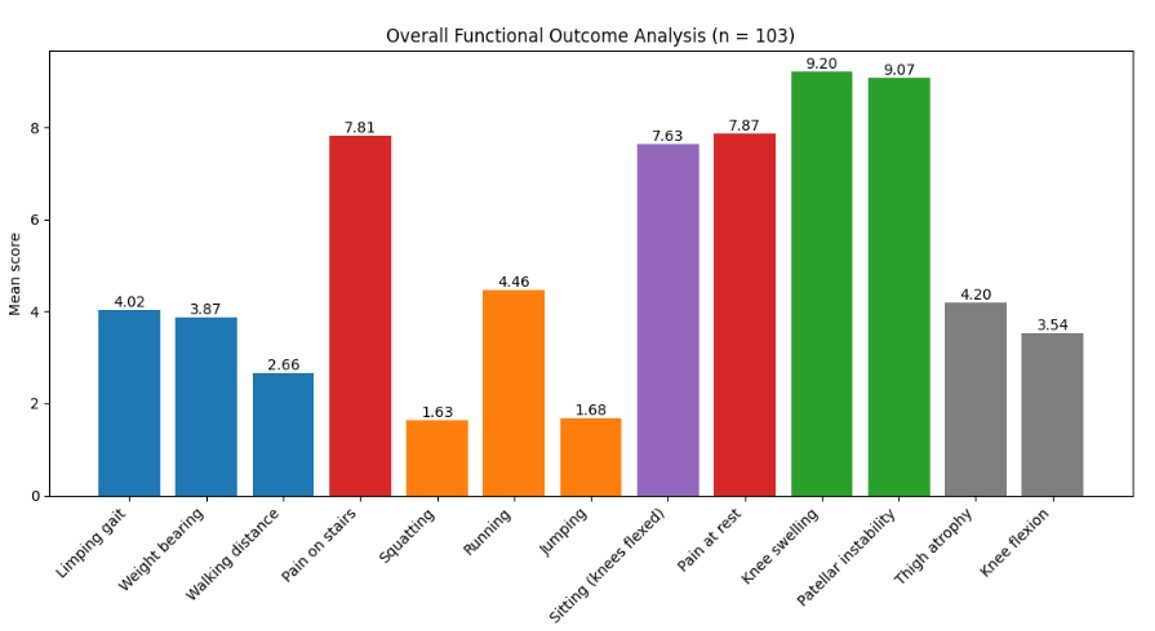
Postoperative Kujala assessment demonstrated substantial improvement across most functional areas (Figure 1). Regarding gait, 69 patients reported never limping, 23 occasionally limped, and 11 always limped, yielding a mean postoperative score of 4.02 (primary = 4.00, revision = 4.04) compared with preoperative scores of 0 in both groups. Weight-bearing ability improved, with 75 patients able to bear full weight without pain, 20 unable to bear full weight without pain, and 8 reported pain during weight bearing, resulting in a mean postoperative score of 3.87 (primary = 3.98, revision = 3.39) compared with a preoperative mean of 2.60 (primary = 2.32, revision = 1.99).
.jpeg)
Walking ability also improved substantially as 63 patients could comfortably walk 1–2 km, 20 reported no difficulty walking any distance, 16 could walk 2–4 km, and 4 remained unable to walk. This corresponded to a mean postoperative score of 2.66 (primary = 2.72, revision = 1.60) compared to a preoperative mean of 2.32 (primary = 2.65, revision = 1.43). Pain-related parameters showed marked improvement. For stair climbing, 57 patients reported no pain, 23 experienced pain when descending stairs, 13 when ascending, and 10 during both activities, resulting in a mean postoperative score of 7.81 (primary = 7.32, revision = 7.30) compared with a preoperative score of 4.30 (primary = 3.01, revision = 3.55). At rest, 33 patients reported no pain, 56 slight occasional pain, 9 severe occasional pain, 4 constant pain, and 1 where pain interfered with sleep, resulting in a mean score of 7.87 (primary = 7.92, revision = 7.32) compared with preoperative scores of 0 in both groups.
Functional activities remained limited in some patients. Squatting was reported as impossible by 57 patients, 19 experienced no difficulty, 9 reported pain afterward, 5 reported pain after repeated squats, and 13 reported pain with partial weight-bearing. The mean postoperative score was 1.63 (primary = 1.94, revision = 1.24), similar to the preoperative mean of 1.63 (primary = 1.86, revision = 0.83). Running ability remained limited as 77 patients reported an inability to run, 16 reported no difficulty, 6 slight pain, and 4 pain after running 2 km, yielding a mean score of 4.46 (primary = 4.21, revision = 3.91) compared with 3.20 preoperatively (primary = 3.46, revision = 1.64). Similarly, jumping remained challenging for many patients as 81 reported substantial difficulty, resulting in a postoperative score of 1.68 (primary = 1.82, revision = 1.54) compared with 1.92 preoperatively (primary = 2.01, revision = 1.45).
Sitting with the knees flexed improved; 61 patients reported no discomfort, producing a mean score of 7.83 (primary = 7.31, revision = 7.35) compared with a preoperative score of 4.21 (primary = 4.82, revision = 3.60). Structural and stability-related parameters also improved. Knee swelling was reported absent in 89 patients, resulting in a postoperative score of 9.20 (primary = 9.50, revision = 8.90) compared with 4.31 preoperatively (primary = 4.53, revision = 3.87). Patellar instability was reported absent in 82 patients, yielding a score of 9.07 (primary = 9.58, revision = 8.55) compared with 6.35 preoperatively (primary = 6.75, revision = 4.04). Thigh atrophy scores also improved from 3.74 (primary = 3.75, revision = 3.18) to 4.20 (primary = 4.60, revision = 3.83), and knee flexion improved from 1.49 (primary = 1.87, revision = 0.58) to 3.54 (primary = 3.55, revision = 2.48).
SF-36 quality of life assessment
Quality of life at 6 months postoperatively was assessed using the SF-36. General health was rated as very good by 45 patients, excellent by 7, good by 39, fair by 11, and poor by 1. Compared with preoperative status, 63 patients reported feeling much better, 32 somewhat better, and 8 about the same. Most patients reported minimal limitations in activities of daily living. For strenuous activities such as running, lifting heavy objects, and vigorous exercise, 61 reported little limitation, 36 substantial limitations, and 6 no limitation. 81 patients reported no limitation in moderate activities such as moving a table, pushing a vacuum cleaner, bowling, or playing golf. Similarly, 101 patients reported no limitation carrying groceries, 94 reported no limitation climbing a single flight of stairs, and 58 reported no limitation with bending, kneeling, or stooping.
Regarding physical role functioning, 92 patients reported cutting down the amount of time spent on work or other activities, and 11 reported no reduction. Sixty-two patients were able to accomplish all intended activities whereas 41 accomplished less than desired. Ninety-five patients reported some limitation in work or daily activities, and 89 reported difficulty performing work-related tasks. Emotional role functioning was generally preserved; 86 patients reported not reducing time spent on work or activities because of emotional problems, and 94 were able to accomplish all desired activities. Social functioning was unaffected in 72 patients, slightly affected in 22, and moderately affected in 9. Similarly, 74 reported that emotional problems interfered with social activities none of the time.
Pain outcomes were favorable. During the 4 weeks before the interview, 23 patients reported no pain, 37 very mild pain, 27 mild pain, and 16 moderate pain. Pain did not interfere with housework in 61 patients, and 28 reported little interference. Vitality and mental health outcomes were also well reported. Most patients reported feeling energetic, calm, and peaceful most or a good bit of the time. Feelings of depression were uncommon; 85 patients reported feeling downhearted and blue none of the time. Furthermore, 89 patients reported feeling happier since the surgery either all the time or most of the time.
Postoperative anterior knee pain
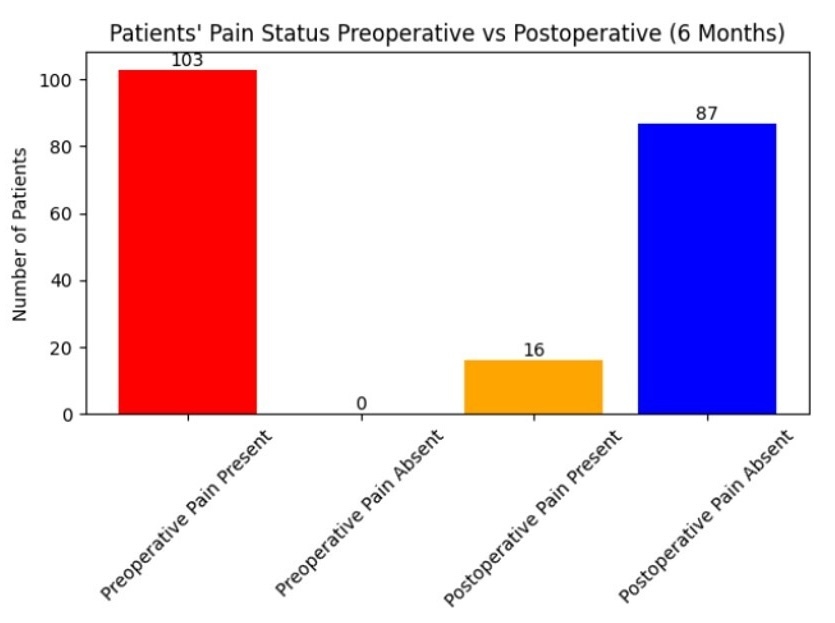
Assessment of satisfaction and quality of life at 6 months post operation was further analyzed using pain status as a dichotomous outcome. Preoperatively, all patients (100%) reported AKP (Figure 2). Six months after surgery, only 16 patients (15.5%; 95% CI: 8.5%–22.5%) continued to report AKP, and 87 patients (84.5%; 95% CI: 77.5%–91.5%) reported complete resolution of pain. Of the 16 patients with residual pain, 12 had undergone primary TKA and 4 had undergone revision TKA. The McNemar’s test demonstrated a statistically significant reduction in AKP following surgery (χ² = 87, P < .0001). The effect size was very large (φ = 0.92), indicating a strong association between TKA and postoperative reduction in AKP.
.jpeg)
Discussion
This retrospective study assessed patients’ functional outcomes, incidence of persistent AKP, and patients’ quality of life following TKA without patella resurfacing in 103 patients with a mean age of 66.65 years. This age group reflects the population undergoing TKA for degenerative osteoarthritis or revision, consistent with other randomized trials and registry-based studies evaluating patella management strategies in TKA.1–4 Significant improvement of the Kujala score (Table 1 and Figure 1) of 67.84 postoperative from 36.07 preoperative represents a good outcome of TKA without patella resurfacing and is a reliable assessment of residual AKP (P ≤.0001 for functional score following TKA) because it is sensitive to activities that involve patellofemoral loading.5
Reports of minimal or no limping with good tolerance to full weight-bearing correlate with other randomized controlled studies with comparable pain relief and good functional outcomes between resurfaced and non-resurfaced patellae.2,6,9 The majority of the study participants reported being able to walk 1–2 km, supporting satisfactory restoration of mechanical mobility after TKA without patella resurfacing. Stair usage was challenging during descent, but similar findings are reported in randomized trials where stair usage was one of the most challenging activities postoperatively, regardless of patella resurfacing status.1,2
High-demand activities like squatting, running, and jumping were limited in this postoperative cohort, with more than half unable to squat, agreeing with studies that demonstrated that flexion and high-demand activities remained problematic after TKA despite patella resurfacing.6,10,11 Meta-analyses found that although patella resurfacing may reduce re-operation rates, it does not reliably restore high-demand patellofemoral function.10,11 Running and jumping scored poorly, but studies discouraged these post-TKA due to increased implant stress, hence limited functional benefits.8,12 Therefore, the low scores in these areas are associated with the predictable postoperative limitations rather than surgical failure.
Patella stability was satisfactory; the majority reported no symptoms of subluxation or instability, aligning with studies of modern prosthesis. Appropriate implant design and proper surgical technique reduce patellofemoral complications, lessening the need for routine patella resurfacing.7,10,13 Findings of mild quadriceps atrophy and limited knee flexion are consistent with studies reporting persistent quadriceps weakness and reduced flexion following TKA despite patella resurfacing techniques.3,6 Postoperative rehabilitation concentrating on quadriceps strengthening and range of motion is highly appropriate.
The SF-36 results showed a clear improvement in general health 6 months postoperative compared with before the operation, and no patients reported deterioration, which is consistent with other cohorts and randomized studies, showing significant improvement in patient quality of life after TKA irrespective of patella resurfacing.3,12
Low-demand activities of daily living, such as self-care, walking short distances, and in-house tasks, were well tolerated, but limitations persisted in high-demand physical activities. The majority of the participants reported reduced productivity and increased effort after the surgery. Similar findings are reported in functional outcome studies, showing pain relief is reliable, but full restoration of physical capability is less predictable.3,4 The majority of participants maintained emotional well-being and social involvement after surgery, which is in line with studies that improved pain control and mobility after TKA, contributing positively to psychosocial outcomes despite persistent physical restrictions.12
Knee swelling was minimally reported, demonstrating good implant tolerance and few significant patellofemoral complications. Persistent AKP was identified in only 15.5% of the participants at 6 months post operation, depicting a substantial reduction in postoperative pain demonstrated by McNemars’ test. This AKP reduction aligns with other randomized trials and registry data with comparable pain relief between resurfaced and non-resurfaced patellae in both the short term and long term.3,4,9
Limitations
The study was conducted in one institution with no comparison group of resurfaced patellae, which limited our findings. The retrospective nature may have introduced the possibility of recall and selection bias because outcomes were collected through telephone interviews. This study only focused on short-term (6 months) outcomes; long-term outcomes were not studied or included. The small number of revision TKA limited subgroup statistical power and restricted more advanced statistical analysis like regression analysis.
Conclusion
TKA without patella resurfacing in this cohort (103) is associated with significant pain reduction at 6 months, good functional outcomes, and higher health-related quality of life. The low incidence of residual AKP (15.5%) and improved mean Kujala score of 67.84 from 36.07 preoperative depicted the benefits of preserving the native patella, reflecting significant patellofemoral function recovery.
The SF-36 results also showed improved general health, emotional well-being, and social participation, highlighting the overall positive impact of non-resurfaced patella in TKA. Comparative studies are still required before recommending this approach over patellar resurfacing. Future studies can be strengthened by having a prospective multi-facility study, a longer follow-up period, and comparing the results with resurfaced patella outcomes.
Acknowledgments
We acknowledge all faculty members of the research center, all patients who participated, and bodies who were involved in the approval of this study.
Ethical Approval
This study was approved by the Institutional Research and Ethics Committee (IREC) of Moi Teaching and Referral Hospital and licensed by NACOSTI; License number NACOSTI/P/25/4176350.
Informed Consent
All participants received detailed information regarding the study, its objectives, procedures, possible risks and benefits and verbal consent was obtained through telephonic interviews and documented. Confidentiality was maintained through anonymous data collection and restricted access to the study records.
Data Availability
The datasets generated and analyzed are not publicly available. However, de-identified data may be made available upon reasonable request, subject to ethical approval.
Conflict of Interest
None
Funding
None