Over the past 27 years, the College of Surgeons of East, Central and Southern Africa (COSECSA) has successfully delivered surgical education across Sub-Saharan Africa through a unique decentralized in-service college-without-walls training model.1 The COSECSA Honorary Fellowship is the College’s highest distinction. It recognizes individuals whose contributions have strengthened surgical care, education, research, leadership, partnerships, and health systems across East, Central, and Southern Africa. The distinction is notable because it has been awarded to a diverse group of individuals: surgeons, educators, examiners, institutional leaders, philanthropists, health advocates, and heads of state. Their recognition reflects a shared contribution to the development of regional surgical capacity.
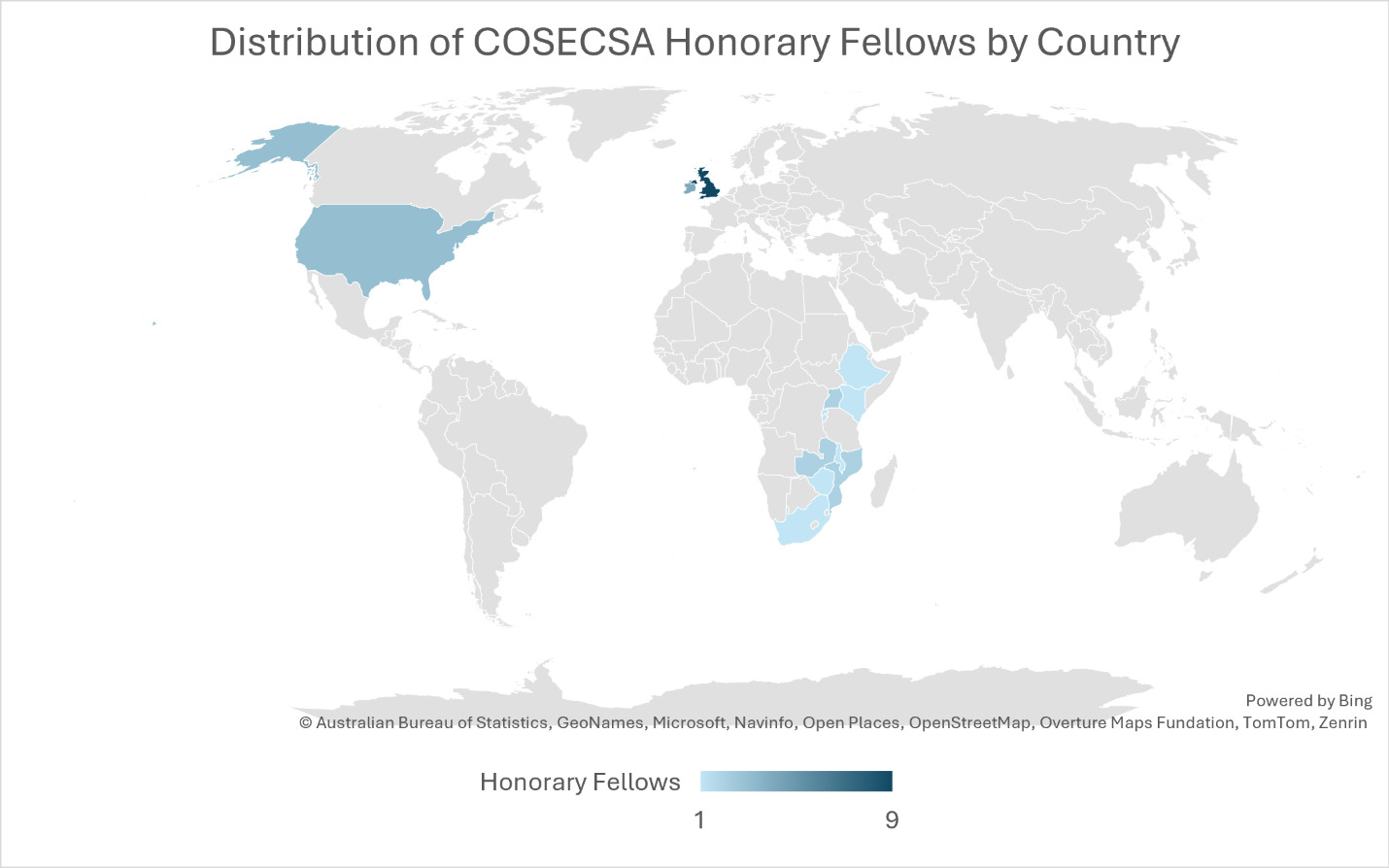
The list of Honorary Fellows illustrates the story behind the significant growth of the College: the teaching, examining, advocacy, partnerships, and leadership that have enabled regional surgical training. The history of COSECSA can be interpreted through the people it has chosen to honor (Table 1 and Figure 1). The Honorary Fellowship is one expression of the College’s institutional memory. It preserves the names of individuals whose work has assisted the growth of the College. COSECSA has matured and been internationally benchmarked. Through teaching, examining, mentoring, partnerships, and advocacy, the Honorary Fellows have influenced this growth. Remembering these contributions matters because surgical capacity in Africa has been built over years, often through work that is less visible than clinical service but just as essential to the endurance of a regional surgical college.2

The names in Table 1 should not be read only as a list of individual honors. Taken together, they describe the networks of mentorship, examination, institutional leadership, philanthropy, public advocacy, and international collaboration that helped shape COSECSA.
A recurring contribution from the Honorary Fellows is the strengthening of surgical education. Across the region, they have helped develop training programs, examine candidates, mentor faculty, and sustain postgraduate surgical education. Their work helped COSECSA develop common standards across countries with diverse health systems, resources, disease burdens, and training environments. COSECSA is a regional training institution that depends on local trainers, regionally accredited hospitals, contextual specialty curricula, and its own examination systems. Support has come from regional and international visiting faculty, institutional partners, and national surgical leaders. Many of the Honorary Fellows have contributed directly to this systematic educational pyramid. Others have created the conditions for the expansion of surgical training through advocacy, philanthropy, public leadership, or institutional partnerships.
Surgical workforce development requires more than just an increase in the number of trainees. It requires trainers, curricula, operating experience, supervision, assessment, research capacity, and professional identity.3 The careers of the Honorary Fellows demonstrate how these elements were built over time and across borders.
The growth and the success of COSECSA have been heavily dependent on collaborative partnerships, and in particular those that have strengthened African leadership. Reinforcing surgical leadership is a strategic objective and a moral imperative. It empowers surgeons to guide teams, manage complexity, shape policy, and mentor the next generation. This translates to improved patient outcomes, enhanced institutional resilience, and the creation of an appropriate professional environment for the African surgical workforce.4
Throughout its relatively short history, COSECSA has worked with a long list of partners. Honorary Fellows have served as the conduits between COSECSA and international organizations, universities, surgical colleges, philanthropic foundations, and professional networks. This network includes the Royal College of Surgeons in Ireland, the Royal College of Surgeons of Edinburgh, Royal College of Surgeons of England, Royal College of Physicians and Surgeons of Glasgow, the American College of Surgeons, AO Alliance, Smile Train, Operation Smile, Kids Operating Room, the Pan-African Academy of Christian Surgeons, ReSurge International, Intuitive Foundation, Mercy Ships, and others. They all represent organizations committed to surgical capacity building. The most durable of these collaborations have moved beyond short-term support through long-term mentorship towards the building of sustainable healthcare systems.
The Honorary Fellowship recognizes the role of public leadership in expanding surgical care. Through leadership roles in universities, ministries of health, surgical colleges, professional societies, philanthropic organizations, international institutions, and national governments, the Honorary Fellows have contributed to making surgery visible as a strategic component of health systems.
Technical skills alone cannot build a regional college. The development of COSECSA required educators, examiners, institution builders, advocates, funders, researchers, and national leaders. The Honorary Fellowship acknowledges that lasting improvements in surgical care often depend on contributions made far beyond the operating theatre.
A collective legacy
Viewed collectively, the COSECSA Honorary Fellows represent much more than individual achievement. Individually, their careers demonstrate that surgical training depends on more than technical skills. Some have built training programmes; some have examined and mentored generations of surgeons. Others created partnerships that supported infrastructure, scholarships, research, and subspecialty development. Many used public leadership, philanthropy, or advocacy to make surgical care more visible within national and regional health priorities.
The legacy of these Honorary Fellows is measured in the surgeons trained, institutions strengthened, standards established, partnerships sustained, and ultimately in the increasing number of patients reached through the expansion of safe surgical care. In honoring these individuals, COSECSA also honors a broader vision: that durable progress in surgery comes from building people, institutions, and systems capable of serving the region for generations.
This history should not be lost. COSECSA’s Honorary Fellows represent an important institutional archive. An official register, brief citation summaries, oral histories, and biographical accounts would help preserve the history of surgical training and partnership across the region. COSECSA and ECAJS can help ensure that the next generation of African surgical leaders understands both the inheritance they have received and the responsibility they now carry forward.
Ethical Approval
Not applicable
Informed Consent
Not applicable
Data Availability
The records used to compile Table 1 were reconciled from available COSECSA print and hard-copy records. Further details may be requested from the COSECSA Secretariat, subject to institutional approval.
Conflict of Interest
Several authors hold leadership, editorial, or institutional roles within COSECSA and/or the East and Central African Journal of Surgery. No financial conflicts of interest were declared.
Funding
None